

Nature Beat #98
Updates, stories, resources and opportunities

Welcome to the latest edition of Global Nature Beat. This edition includes:
Updates on UK climate and nature aid, missing biodiversity reports, India’s environment, next steps for roadmaps on deforestation and fossil fuels, environmental crime.
Features about biodiversity journalism, bird declines, community forests, river restoration, AI poacher monitoring, and more.
Journal papers on plants and climate change, nature connectedness, conservation agriculture, overstated biodiversity declines, nature and the human brain, gaps in seed banks, the Global Biodiversity Framework, and more.
Plus, the usual mix of news from around the world, useful resources, jobs and opportunities for environmental journalists, and more.
Taking The Pulse
Biodiversity: Only half of the 196 parties to the UN Convention on Biological Diversity (CBD) met the 28 February deadline for submitting national reports on their progress towards the targets of the Global Biodiversity Framework — see Daisy Dunne’s analysis for Carbon Brief. The reports are essential for the CBD’s first global review of progress, which will be shared at the UN Biodiversity Conference later this year. As of today, 101 parties have submitted their reports. But still absent are reports from some of the world’s most biodiverse countries such as Argentina, Brazil, China, the Democratic Republic of the Congo and Papua New Guinea.
UK climate and nature aid: As Fiona Harvey reported on 2 March, the UK government is quietly slashing major climate and nature aid programmes for developing countries, undermining its international finance pledges and its purported international leadership on climate change and biodiversity. Also on 2 March, a group of 86 civil society organisations wrote to Prime Minister Keir Starmer to call for an increase in climate funding, to be financed by taxing polluters and redirecting subsidies for fossil fuel companies. Last month, 25 environmental groups published another letter to Starmer urging his government to invest in the Tropical Forest Forever Facility and to ensure that nature-based solutions and forest protection and restoration “demonstrably and transparently” represent one-third of the UK’s international climate finance commitments.
Roadmaps: Brazil — as current President of the UN climate change negotiations — has invited contributions to the two roadmaps it is developing to guide the transition away from fossil fuels, and to halt and reverse deforestation and forest loss by 2030.
Environmental crime: Justin Gosling of the Environmental Investigation Agency wrote about how UN negotiations on tackling environmental crime collapsed last week without agreement after powerful countries resisted a new protocol.
India: Down To Earth published videos and presentations from last week’s Anil Agarwal Dialogue — the Centre for Science and Environment’s annual conclave on environment-development challenges facing India and the world. See also news stories from the event on invasive species, rising human-wildlife conflict linked a ban on hunting, ecological and social limits to current conservation approaches, and the 2026 State of India’s Environment report.
In Focus: Global Biodiversity Framework
Three new papers touch on different aspects of the Global Biodiversity Framework — the strategy to halt and reverse the loss of nature by 2030 that parties to the UN Convention on Biological Diversity adopted in 2022.
Stuart Pimm and colleagues note “a disconnect between unsupported claims about impending planetary doom and carefully documented evidence of conservation’s successes and failures”. They recommend quantitative targets for conservation and nature restoration, identify four key knowledge gaps and call for transparent communication about conservation outcomes — read the full paper.
Pil Pedersen and colleagues presented a way to rigorously assess national contributions to the GBF’s ‘30×30’ target — to protect 30 percent of land and sea by 2030. Applying the framework to Denmark revealed that official reporting significantly overestimates progress towards the target by failing to reflect whether protection is effective — see the press release or the full paper. The researchers say: “Without rigorous evaluation, the 30x30 target risks becoming a symbolic rather than transformative driver of change.”
Erik Petter Axelsson and Ulrik Ilstedt wrote about how slow ecological recovery in tropical forests undermines the Global Biodiversity Framework’s short‑term timelines. They argue that this demands far longer‑term protection, restoration, and policy commitments than current goals allow — read the full paper.
In The Spotlight
John Cannon wrote about how the world’s ambitious biodiversity targets are colliding with stark funding shortfalls with the new Global Biodiversity Framework Fund delivering only a tiny fraction of the money needed to halt nature loss.
Melissa Hobson, Fonda Mwangi, Alex Sugiura and Kendra Pierre‑Louis reported on an artificial intelligence model that can detect gunshots in noisy rainforests, potentially enabling real‑time monitoring to help rangers stop poaching.
Warren Cornwall wrote about scientists uncovering steep, climate‑linked declines in insect‑eating birds across intact tropical forests.
In the Democratic Republic of the Congo, more than 100 active mining permits overlap community forests intended to promote sustainable livelihoods and conserve biodiversity, reports Jonas Kiriko.
bioGraphic published a special package of four stories showing how biodiversity protection and conservation science are changing one year into the second term of US President Donald Trump.
Juliet Grable wrote about how the Klamath River is rapidly rebounding after dam removal, with Tribal‑led crews reseeding thousands of acres and salmon swiftly reclaiming long‑inaccessible habitat.
Ruth Thornton wrote about how the biodiversity crisis is gravely under‑reported compared with climate change and how better storytelling could help drive meaningful action to protect nature.
From The Journals
Climate change is causing some tropical plants to flower weeks earlier or later than they used to — read the press release or the full paper.
Conservation agriculture boosted crop yield by up to 122 percent in an Ethiopian trial — read the full paper.
The Living Planet Index and ‘planetary boundaries’ for biodiversity integrity overstate claims of wildlife collapse and risk distracting from evidence‑based conservation — read the full paper.
Study links accelerating declines in North American bird abundance with agricultural intensity — read the press release or the full paper.
Historical newspaper archives can enrich biodiversity databases by providing insights into changing patterns of species distribution — read the full paper.
A review of more than one hundred studies shows how spending time in nature triggers changes in the brain that calm stress and restore attention — read the press release or the full paper.
Nature connectedness is significantly higher in the Global South than the Global North — read the full paper.
The likely number of bee species is thousands higher than previously thought — read the press release or the full paper.
A global network of seed banks holds samples of only 7.2 percent of critically endangered plant species and, for most of them, the numbers and diversity of seeds are low — read the full paper.
What Caught My Eye
California approved US$60 million in grants to protect biodiversity, restore important wildlife habitats, and improve public access to nature.
Environmental journalism in the Western Balkans is failing to match the region’s escalating ecological crises according to research by the Earth Journalism Network — read the summary article or the full report.
Britain’s biggest asset manager, Legal & General, has committed up to US$1 billion to invest in ‘debt-for-nature’ swaps over the next five years.
Fourteen African governments pledged to mobilize US$400 million for responsible forest management, restoration and value-added forest industrialization.
Only a third of the world’s land is covered by formally documented ownership, tenure or use rights, according to the Status of Land Tenure and Governance report— see the press release.
The meat and dairy sector is not only the biggest driver of deforestation but also the top threat to grasslands, savannas and wetlands, reports Georgina Gustin.
Jeremy Hance reported on growing concerns about an emerging mental health crisis in the conservation sector.
Members of the Global Youth Biodiversity Network wrote about being sidelined at a recent meeting under the Convention on Biological Diversity and why meaningful youth participation is essential.
Isaiah Esipisu interviewed Luther Bois Anukur —the International Union for Conservation of Nature’s Regional Director for Eastern and Southern Africa — about how Africa can shift from dwindling donor support to community‑centred and nationally financed conservation.
Condors appear to be nesting in Northern California for the first time in 100 years.
Mongabay’s new Indigenous Desk will expand independent environmental journalism focusing on Indigenous perspectives and sources.
TRAFFIC published a report on Germany’s role in the global trade in wild plants.
Miguel Ángel Gómez‑Serrano says small changes to EU law could curb the harmful impacts of pet animals on biodiversity.
Toxic chemicals from discarded screens are accumulating in endangered dolphins and porpoises, reports Tara Russell.
How to Support Global Nature Beat
I publish this newsletter as a free service to thousands of readers in more than 120 countries. If that is something you can support, please consider becoming a paying subscriber for less than £1 a week. If you can spare that, you will be helping me to keep Global Nature Beat going for those who cannot afford to pay.
Tips And Resources
On 4 March, Dialogue Earth is hosting a webinar asking: Will 2026 bring real progress on ocean justice?
Joseph A. Davis wrote a backgrounder on recent studies showing that enforcement of US environmental protection laws fell to a record low in the first year of the current Trump administration.
The Nature Crime Alliance published a briefing paper on challenges facing investigative journalists reporting on environmental crime worldwide, and ways to strengthen the field.
On 5 March, the Secretariat of the Convention on the Conservation of Migratory Species is holding a media briefing on the 15th Conference of Parties taking place later this month — register here.
Skyler Ware shared tips on how to fund and plan reporting trips.
See past editions for more tips and resources.
Jobs And Opportunities
Jamma Conservation & Communities has grants for Africa-focused stories that explore conservation through a human lens — deadline 8 March.
Nature is advertising a science journalism internship — deadline 9 March.
The Earth Journalism Network has grants for media organizations in low- and middle-income countries proposing projects that strengthen media reporting on biodiversity issues — deadline 28 March.
Mongabay invites applications for its Portuguese-language reporting fellowship — deadline 31 March.
WBHM public radio in Alabama, United States, seeks an environmental reporter — no deadline listed.
South Asia Speaks launched a fellowship for writers in the region working on book-length projects that engage seriously with science — deadline 30 March.
The Eric and Wendy Schmidt Awards for Excellence in Science Communications, are open for entries — deadline 3 April.
Bonus content: There are 38 jobs, grants, fellowships and other opportunities listed here for Global Nature Beat’s paying supporters. Paid subscriptions are less than £1 per week.
On The Horizon
21 March: International Day of Forests.
23-29 March: The 15th Conference of Parties to the Convention on Migratory Species takes place in Campo Grande, Brazil.
21-24 April: The 4th Conference of Parties to the Escazú Agreement takes place in Nassau, Bahamas.
12-15 April: The 4th Global Soil Biodiversity Conference takes place in Victoria, Canada.
Bonus content: The full calendar for Global Nature Beat’s supporters includes nature-related intergovernmental negotiations, scientific conferences, report launches, and other events up until 2028.
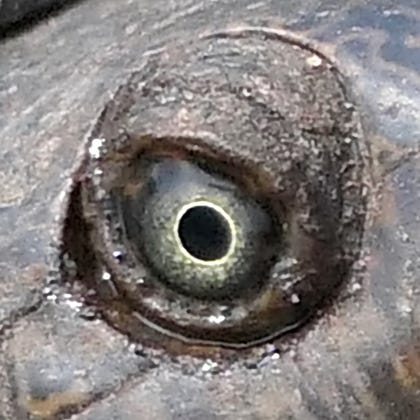
Whose Eye Was It?
The eye belongs to a serrated hinged terrapin. Photo credit: Bernard Dupont— Wikimedia Commons.
Thanks for reading. For past editions, see the Archive. If you found it interesting or useful, please share and subscribe. If you want to get in contact, you can reach me at: thenaturebeat@substack.com.
Take A Trip to Planet Ficus
My other newsletter Planet Ficus is devoted to stories about the world’s most fascinating plants — the strangler figs and their kin, which have shaped our world and our species in profound ways. Take a trip there for a rich mix of stories about the ecological and cultural importance of these trees.

.jpg)
Thank you Mike! Always appreciate these.