

Nature Beat #97
Updates, stories, resources and opportunities

Welcome to the latest edition of Global Nature Beat. This edition includes:
Updates on biodiversity negotiations and deforestation in the Amazon.
Features about whale sharks, invasive mussels, conflict with baboons, militarized rhino protection, vulture safe zones, and more.
Journal papers on ecological impacts of wildfire smoke, key biodiversity areas, commodity-driven deforestation, fish food webs, biodiversity monitoring, and more.
Plus, the usual mix of news from around the world, useful resources, jobs and opportunities for environmental journalists, and more.
Taking The Pulse
Biodiversity: Parties to the UN Convention on Biological Diversity (CBD) met in Rome last week for the latest meeting of their Subsidiary Body on Implementation. While the CBD Secretariat’s press release put a positive spin on the meeting, most of the key texts that negotiators discussed remain full of square brackets indicating disagreement — see Stella Paul’s reporting or the Earth Negotiations Bulletin’s summary of the meeting.
Later this year, the Conference of Parties will conduct the first review of progress under the Global Biodiversity Framework, which sets out 23 targets to be achieved by 2030. The review depends on countries submitting their latest national reports. But at the time of writing, only six of the CBD’s 196 parties — the European Union, Japan, Lesotho, Sudan, Switzerland and Uganda — had submitted their reports. The deadline of 28 February is looming. The CBD secretariat’s interim analysis of the national strategies and targets that parties have developed shows that, despite some progress, there are major gaps.
Amazon: Brazil is on track to record the lowest rate of Amazon deforestation since 1988, says its environment minister Marina Silva. As Yale e360 reports, this is the result of increased enforcement against illegal deforestation by miners, loggers and farmers. But there are now widespread fears that this progress could be rapidly reversed as soy farmers abandon a ten-year old voluntary moratorium on expansion into the Amazon. Members of the Forests & Finance coalition of environmental and research organizations are urging banks that finance the soy producers to require them to comply with the moratorium’s core principles — see the commentary by Ginger Cassady, head of coalition member Rainforest Action Network.
In The Spotlight
With support of a training project, coastal communities in India have saved and released more than a thousand endangered whale sharks caught in fishing nets, reports K.A. Shaji.
Sofia Moutinho wrote about the rapid spread of the invasive golden mussel into the Amazon, where it is damaging ecosystems, infrastructure and livelihoods, while outpacing efforts to control it.
The Gecko Project reported how the president of Sierra Leone ignored evidence that a senior politician enabled illegal encroachment of a national park so elites could build mansions.
Jaylan Sims reported on how an invasive vine — once promoted as a ‘miracle plant’ — intensifies wildfire risks across the southern United States.
Adam Welz reported on Cape Town’s controversial plans for dealing with escalating conflicts between people and baboons.
Tulani Ngwenya wrote about how foreign funding and hi‑tech tools have transformed South Africa’s rhino protection efforts into a militarised system that monitors people as much as wildlife.
Citizen scientists in India are generating millions of biodiversity observations but, as Sahana Ghosh reports, there is a lack of expert capacity, infrastructure and long‑term support needed to turn this data into policy‑shaping science.
Sean Mowbray wrote about the challenges of creating vulture safe zones in Africa and Asia.
From The Journals
How to build a modern, integrated biodiversity monitoring system for Europe — read the press release or the full paper.
Direct, indirect and cascading effects of wildfire smoke on organisms and ecosystems — read the full paper.
Global patterns of commodity-driven deforestation and associated carbon emissions — read the full paper.
The first global audit of the planet’s key biodiversity areas and their use by governments, businesses and others — read the full paper.
We know little about the effects of releasing millions of mallard ducks for recreational hunting — read the full paper.
Implications of African infrastructure development for threatened species — read the full paper.
Fish food webs have changed substantially over recent decades, even in places where the number of species has remained stable — read the press release or the full paper.
What Caught My Eye
Investigations are underway after 72 — yes, seventy-two — tigers died this month at two wildlife parks in Thailand.
A Malaysian court has issued three Vietnamese nationals with fines totalling almost US$32 million and 12-year jail sentences after convicting them of illegally possessing endangered wildlife parts.
Marina Adami spoke with Anthony Feinstein about his research on mental health risks among climate reporters in the Global South.
Chidinma Iwu wrote about a nongovernmental organization working with coastal communities in Nigeria to address a growing problem with ghost nets.
Researchers say the global ‘30×30’ biodiversity targets must recognize African spiritual landscapes.
Ben Deighton wrote about how US-led cuts to international development funding have eroded science journalism worldwide by ending grants that support investigative reporting.
Indonesia is preparing a policy framework, pilot projects and implementation roadmap for high integrity biodiversity credits, reports Sugiharto Budiman.
Artificial mangrove roots are being installed on Thai beaches to trap sediment and aid mangrove restoration, reports Shuchita Jha.
Liam Ferguson wrote about how Indigenous researchers are working to define and protect culturally significant species by embedding their knowledge and authority into Australia’s national biodiversity laws and management systems.
The Commonwealth Secretariat and Guyana announced plans for a Commonwealth Centre of Excellence for Biodiversity.
Tom Peeters wrote about Serbia’s eastern imperial eagles rebounding thanks to determined conservation work.
The latest edition of the annual State of Global Environmental Governance report is out.
How to Support Global Nature Beat
I publish this newsletter as a free service to thousands of readers in more than 120 countries. If that is something you can support, please consider becoming a paying subscriber for less than £1 a week. If you can spare that, you will be helping me to keep Global Nature Beat going for those who cannot afford to pay.
Tips And Resources
On 25 February, Project Drawdown has a webinar looking at whether mainstream media is under-reporting the most urgently needed climate solutions — register here.
Related to this, Amanda Royal recently delivered a fiery rebuke of mainstream coverage of climate change, slamming its failure to inspire action and calling for a solutions-focused reset.
On 26 February, Journalismfund Europe has a webinar on environmental investigations and the law — register here.
On 12 March, Journalismfund Europe has a webinar all about how to launch an environmental investigative podcast — register here.
Rhett Ayers Butler wrote a useful explainer about how marine heatwaves are driving increasingly severe global coral bleaching.
See past editions for more tips and resources.
Jobs And Opportunities
The Environmental Journalism Story Incubator mini-fellowship includes a one-day workshop, registration for the Society for Environmental Journalists’ conference and a stipend for travel and lodging —deadline 2 March.
The Guardian is hiring an assistant environment editor — deadline 5 March.
Apply here for the Introduction to Investigative Journalism training course offered by GIJN and iMEdD — deadline 6 March.
The Guardian US is hiring a senior climate justice reporter — no deadline listed.
The Center for Media Research–Nepal invites Nepali journalists to apply for its Climate Change Reporting Fellowship 2026 — deadline 15 March.
Dialogue Earth is hiring a regional editor for Mexico and Central America — deadline 16 March.
Bonus content: There are 41 jobs, grants, fellowships and other opportunities listed here for Global Nature Beat’s paying supporters. Paid subscriptions are less than £1 per week.
On The Horizon
16-19 February: The UN Convention on Biological Diversity’s Subsidiary Body on Implementation meets in Rome, Italy.
25–27 February: 25th World Sustainable Development Summit takes place in New Delhi, India.
23-29 March: The 15th Conference of Parties to the Convention on Migratory Species takes place in Campo Grande, Brazil.
12-15 April: The 4th Global Soil Biodiversity Conference takes place in Victoria, Canada.
15-19 April: The International Journalism Festival takes place in Perugia, Italy.
20-24 April: The Species on the Move conference takes place at Sun Moon Lake, Taiwan.
Bonus content: The full calendar for Global Nature Beat’s supporters includes nature-related intergovernmental negotiations, scientific conferences, report launches, and other events up until 2028.
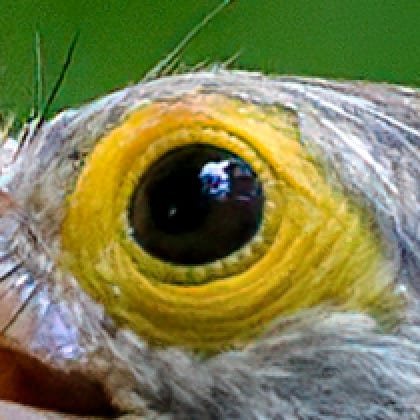
Whose Eye Was It?
The eye belongs to a lineated barbet . Photo credit: Mahmudul Bari— Wikimedia Commons.
Thanks for reading. For past editions, see the Archive. If you found it interesting or useful, please share and subscribe. If you want to get in contact, you can reach me at: thenaturebeat@substack.com.
Take A Trip to Planet Ficus
My other newsletter Planet Ficus is devoted to stories about the world’s most fascinating plants — the strangler figs and their kin, which have shaped our world and our species in profound ways. Take a trip there for a rich mix of stories about the ecological and cultural importance of these trees.

,_NBG,_Dhaka%E2%80%93DSC4338.jpg)
Loved that news about the whale sharks.