

Nature Beat #95
Updates, stories, resources and opportunities

Welcome to the latest edition of Global Nature Beat. If you are new here, read my About page to find out what this newsletter is, who I am and why I am doing this. This edition includes:
Updates on business and nature, plastics treaty, biodiversity negotiations, climate journalism, conservation evidence, and more.
Features about frogs in Ecuador, savannahs in India, safeguarding seeds in Chile, community forests in Nepal.
Journal papers on forests and floods, pesticides and wildlife, bending the curve of biodiversity loss, positive criminology for environmental crimes, payments for ecosystem services, and more.
Plus, the usual mix of news from around the world, useful resources, jobs and opportunities for environmental journalists, and more.
Taking The Pulse
Business and nature: Every business both depends on and affects biodiversity, so has a role to play in halting and reversing the loss of nature. This is the core message of an assessment published by the Intergovernmental Panel on Biodiversity and Ecosystem Services (IPBES) on 9 February. The report highlights a perverse situation: the growth of the global economy has come at a cost to nature, which is now unravelling in ways that pose a systemic risk to the economy, financial stability and human wellbeing. More than 150 governments approved the assessment. It highlights more than a hundred actions that businesses, governments, financial institutions and civil society can take. Businesses no longer have an excuse to avoid their responsibilities. As the IPBES press release states, they “can either lead transformative change or risk extinction”.
Berta Cáceres: A new report says the murder of Honduran environmental activist and indigenous leader Berta Cáceres in 2016 was funded by money originating from international development banks. It says a criminal network spent some of the millions of dollars it diverted from the Agua Zarca hydroelectric project to pay for illegal surveillance, armed incursions and the assassination of Cáceres — all to protect the interests of the project and its investors.
Biodiversity: From 16-19 February, Parties to the UN Convention on Biological Diversity (CBD) will be in Rome, Italy for the sixth meeting of the convention’s Subsidiary Body on Implementation. Negotiations will focus on elements of work to implement the CBD’s Global Biodiversity Framework — including on finance, capacity building and gender. Also on the agenda are updates on national biodiversity strategies and action plans, national targets and national reporting that will feed into this year’s global review of progress in the implementation of the Global Biodiversity Framework — see the International Union for the Conservation of Nature’s position paper or the Earth Negotiations Bulletin’s daily coverage.
Plastics: Governments met in Geneva on 7 February to choose a new chair of negotiations towards a global treaty on plastic pollution. AFP reports that oil producing states had backed a representative of Pakistan and called for more time to reach a consensus, which some other countries dismissed as delaying tactics. Instead, voting took place and Chilean diplomat Julio Cordano was elected.
Conservation evidence: An editorial in Nature argues that global conservation efforts are undermined by weak, inaccessible evidence. It calls for a major push to improve how research is gathered, assessed and used in policymaking. Writing for Mongabay, Tanya O’Garra — chair of the Society for Conservation Biology’s Impact Evaluation Working Group — says conservation programs must make causal evaluation standard practice to understand what truly works and avoid wasting scarce resources. “Without causal evidence, we are effectively engaging in ‘magical thinking’, spending limited funds and hoping for impact,” she writes. “With biodiversity in crisis, we can’t afford to keep guessing whether our actions work.”
The Planet Burns in Darkness
As Sammy Roth reported on 4 February, the Washington Post has fired at least 14 members of its climate change team as part of wider layoffs of more than 300 staff. The sackings come just four years after then-executive editor Sally Buzbee called global warming “perhaps the century’s biggest story”.
Brianna Sacks, the paper’s disaster correspondent, wrote on LinkedIn that there are now only four reporters to cover climate change globally. “During his call this morning announcing the layoffs, Executive Editor Matt Murray even called out the Climate Team for our stellar work,” she wrote. “And then they fired nearly everyone on it.”
It is not just the Washington Post. In the past few years, the number of climate change stories published by five major US media outlets has fallen by about one-third — see Chris Mooney’s chart.
“The scaling back of climate reporting is not just a loss of stories,” writes Rhett Ayers Butler, founder of Mongabay. “It represents a thinning of the informational infrastructure that allows societies to recognize problems early enough to respond.”
In The Spotlight
Scientists are racing to document Ecuador’s extraordinary frog diversity before habitat loss, disease and climate change drive many species to extinction, reports Tali Santos.
Sharmila Vaidyanathan reported on research showing that centuries of traditional Marathi-language literature challenge the idea that savannah ecosystems in Maharashtra, India, are degraded forests.
John Bartlett wrote about Chile’s remote Initihuasi seed bank — a genetic ‘Noah’s Ark’ safeguarding the nation’s rare and endangered plants for a climate‑stressed future.
Nepal’s community forests are producing large volumes of timber that remain unsold, leaving local groups without funds to implement sustainable forest management, reports Mukesh Pokhrel.
From The Journals
YouTube content on wildlife engages audiences but rarely drives meaningful conservation action — read the press release or the full paper.
Soundscape data shows how biodiversity has recovered through Costa Rica’s system of paying farmers to restore forests — read the full paper.
Five ways positive criminology can help to halt and reverse biodiversity loss — read the full paper.
Pesticide harm to wildlife is rising globally despite a global pledge to halve it by 2030 — read the press release or the full paper.
Global models exploring how to reverse biodiversity loss are rare and most do not consider climate change, highlighting a need for integrated action — read the full paper.
Half of the world’s coral reefs suffered major bleaching during a recent global heatwave, and an even more severe event has begun — read the press release or the full paper.
The conventional view that forests cannot mitigate large floods is scientifically indefensible — read the full paper.
What Caught My Eye
Dataphyte published research on how Nigerian media outlets cover biodiversity-related issues, with recommendations for improving the quality and impact of reporting.
Belize became the 38th member of the Forest & Climate Leaders’ Partnership.
Mexico is considering reducing the protected habitat of the critically endangered vaquita by more than 85 per cent.
Marie Hale argues that slowing biodiversity loss depends on community‑centred conservation approaches that recognise landscapes as interconnected social–ecological systems.
Carbon Brief spoke to biodiversity scientists about the chances of reversing nature loss — to read their responses, scroll down here to find the ‘can humans reverse nature decline?’
The government of Laos has approved a strategy for integrating biodiversity conservation and sustainable use into its agriculture and forestry sectors.
Almost half of the world’s aquatic environments are severely contaminated by waste, say researchers in Brazil.
Reina Otsuka and colleagues introduced a tool for assessing countries’ digital readiness to implement their biodiversity commitments.
Conservationist Rick MacPherson outlines what “honest” protection can look like if the world fails to properly protect 30 percent of the ocean by 2030.
Pesticide Action Network warns that 49 pesticides would receive unlimited approval under the European Commission’s proposed new rules for food and feed safety.
Bolivia has created four new protected areas covering 907,244 hectares of Amazon lowlands and Andean highlands, reports Maxwell Gladwin.
An underwater acoustic deterrent system could prevent 90 percent of fish from entering a UK nuclear power plant’s water intake pipes but will cost £700 million, reports Jillian Ambrose.
Thousands of non-native plant species could now find suitable conditions in the Arctic because of global warming, reports Austin Burgess.
How to Support Global Nature Beat
I publish this newsletter as a free service to thousands of readers in more than 120 countries. If that is something you can support, please consider becoming a paying subscriber for less than £1 a week. If you can spare that, you will be helping me to keep Global Nature Beat going for those who cannot afford to pay.
Tips And Resources
Rowan Philp shared tips for impactful climate change reporting.
The Environmental Investigation Agency expanded its Global Environmental Crime Tracker — a public database — to include new and improved information on illegalities in the timber sector
Australia’s new Nature Media Centre aims to improve media coverage of biodiversity by connecting journalists with trusted sources, knowledge and solutions, writes Tom Nicol — see also Mongabay’s new Australian Biodiversity Special Reporting Project.
See past editions for more tips and resources.
Jobs And Opportunities
The Poynter Institute has a new US$10,000 prize for climate change reporting — deadline 13 February.
Journalists from Indonesia and Vietnam can apply to attend the Earth Journalism Network’s workshop on forest governance — deadline extended to 13 February.
Politico is hiring a California energy, environment and climate editor — no deadline listed.
Montana Free Press is hiring a reporter to cover wildlife, public lands, water and wildfire, and their impacts on communities and landscapes in the Greater Yellowstone Ecosystem — no deadline listed.
The Earth Journalism Network has grants for media outlets to cover natural resource management and green growth in Nepal — deadline 15 February.
Dialogue Earth invites pitches from photojournalists and visual storytellers in Southeast Asia on underreported issues at the intersection of environment, conflict and political change — deadline 19 February.
Historias sin Fronteras invites journalists in Latin America to apply for a grant to develop a cross-border story on the dialogue between science and ancestral knowledge in the conservation of biodiversity — deadline 20 February.
The Pulitzer Center has grants for environmental journalism focusing on transparency and governance — deadline 28 February.
Bonus content: There are 43 jobs, grants, fellowships and other opportunities listed here for Global Nature Beat’s paying supporters. Paid subscriptions are less than £1 per week.
On The Horizon
14-16 February: The Corals, Coasts and One Health conference takes place in Saudi Arabia.
16-19 February: The UN Convention on Biological Diversity’s Subsidiary Body on Implementation meets in Rome, Italy.
25–27 February: 25th World Sustainable Development Summit takes place in New Delhi, India.
23-29 March: The 15th Conference of Parties to the Convention on Migratory Species takes place in Campo Grande, Brazil.
Bonus content: The full calendar for Global Nature Beat’s supporters includes nature-related intergovernmental negotiations, scientific conferences, report launches, and other events up until 2028.
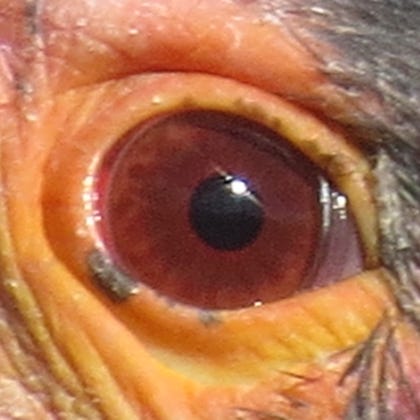
Whose Eye Was It?
The eye belongs to a California condor. Photo credit: Kong of Lasers — Wikimedia Commons.
Thanks for reading. For past editions, see the Archive. If you found it interesting or useful, please share and subscribe. If you want to get in contact, you can reach me at: thenaturebeat@substack.com.
Take A Trip to Planet Ficus
My other newsletter Planet Ficus is devoted to stories about the world’s most fascinating plants — the strangler figs and their kin, which have shaped our world and our species in profound ways. Take a trip there for a rich mix of stories about the ecological and cultural importance of these trees.

