

Nature Beat #94
Updates, stories, resources and opportunities

Welcome to the latest edition of Global Nature Beat. If you are new here, read my About page to find out what this newsletter is, who I am and why I am doing this. This edition includes:
Updates on ocean sustainability and geopolitics, the business case for nature, the US Endangered Species Act.
Features about saving the whales again, forest education for a million schoolkids, protecting Ukraine’s rare plants, Indigenous journalists in the Amazon, a once-reviled and now-revered bird, and forests as health protectors.
Journal papers on sponge cities, ocean equity, mining and biodiversity, tree planting to mitigate climate change, the biosphere in the Anthropocene, and more.
Plus the usual mix of news from around the world, useful resources, jobs and opportunities for environmental journalists, and more.
Taking The Pulse
Business and biodiversity: Representatives of 152 governments are meeting in Manchester, United Kingdom on 3-8 February for the 12th Plenary Session of the Intergovernmental Panel on Biodiversity and Ecosystem Services (IPBES). The major news will be their expected approval and launch of a new IPBES assessment of how businesses affect and depend on biodiversity. The report, developed over three years, will provide guidance for businesses and financial institutions to move towards nature-positive outcomes. For a preview, see the IPBES primer on the report or listen to the new episode of the IPBES podcast. The Earth Negotiations Bulletin will provide daily coverage of the meeting — see also the British Ecological Society’s new beginner’s guide to IPBES.
US Endangered Species Act: On 28 January, the Center for Biological Diversity (CBD) sued the Trump administration for failing to release public records about regulatory reforms that would remove Endangered Species Act (ESA) protections for hundreds of species. One day earlier, CBD staff published research stating that 2,204 species should be considered for protection under the ESA. The CBD notes that the budget for such assessments has been slashed, and there is already a backlog of 400 species awaiting decisions. With an average of just 32 species approved for protection each year, it says many species could be extinct before they are even considered — see the press release. Meanwhile, new research highlights that while the ESA is species-focused, benefits cascade to other species and broader ecosystems.
Ocean: Karina Barquet, Jonathan Green and Maria Sköld say 2026 will be defined by a powerful tension between rising ambition for ocean‑based climate and biodiversity action and escalating geopolitical competition over marine space and resources. A case in point is the upcoming decision of where to host the headquarters of the new treaty on biodiversity in international waters. As Jiang Mengnan, Daniel Cressey and Regina Lam explain, China’s bid to host the secretariat is a strategic move to expand its influence in global ocean governance amid geopolitical tensions.
In The Spotlight
Erica Gies reported on research showing that being in forests may boost lung and immune health, though the scale and mechanisms of these benefits remain uncertain.
Catherine Early wrote about the growing threat to whales from ship collisions, and solutions ranging from ship re-routing and speed reductions to acoustic sensors and thermal imaging technology.
Cecilia Nowell reported on the Ukrainian botanists racing to save rare plants as Russian occupation cuts off key biodiversity sites and threatens the country’s scientific heritage.
Over ten years, the Forest Department of India’s Madhya Pradesh state has brought nearly one million schoolchildren into forests to learn about biodiversity, conservation and coexistence through direct experience, writes Pradeep Mishra.
Kamala Thiagarajan wrote about the ‘army’ of 20,000 women in Indian villages who have transformed attitudes towards a once‑reviled species of stork through grassroots conservation.
Leonardo Coelho wrote about Sumaúma’s Mycelium program, which is training a new generation of ‘forest journalists’ who blend Indigenous storytelling with traditional reporting to reshape how Amazon stories are told.
From The Journals
China’s Sponge City Program reconciles stormwater management with biodiversity conservation and has lessons for other Asian countries — read the full paper.
The Ocean Equity Index: a framework for assessing and improving equity in ocean initiatives, projects and policies — read the press release or the full paper.
Social movements are key allies for biodiversity conservation — read the press release or the full paper.
The many pathways of mining impacts on biodiversity — read the full paper.
Tree planting in northern forests could help Canada become carbon neutral by mid-century — read the press release or the full paper.
Synthesis study shows agricultural diversification increases long-term financial profitability, biodiversity, soil quality and climate change mitigation benefits — read the full paper.
Land needed for carbon removal projects to address climate change overlaps with areas important for biodiversity — read the press release or the full paper.
Eighteen open-access papers on the biosphere in the Anthropocene — read the full papers.
What Caught My Eye
Unexpectedly healthy polar bears on the island of Svalbard may be adapting to global warming through dietary shifts, reports Benji Jones.
Amal Ahmed reports that lawmakers in the US state of Oregon are considering a 1.25 percent tourism tax increase to generate US$30 million a year for conservation, potentially creating a model for other states.
Aida Greenbury says errant companies, not taxpayers, should be paying to restore Indonesia’s damaged forest ecosystems.
Stefano Giglio, Joachim Rillo and Johannes Stroebel wrote about the economic implications of biodiversity loss in the Asia‑Pacific region.
Italy has roughly 440 million abandoned olive trees — Federica Romano explains why this is a problem and how people are trying to address it.
An annual survey shows that Malaysia has lost about 20 percent of its coral reefs since 2022, reports Benjamin Lee.
International trade controls alone will not protect sharks from overfishing, says researcher Hollie Booth.
The Global Landscapes Forum selected five candidates from Brazil, Cameroon, Indonesia, Peru and Uganda as its latest cohort of Restoration Stewards for oceans, forests, drylands, mountains and wetlands.
Biodiversity-friendly tea certification could strengthen rural livelihoods in China, says a new report.
Sophus zu Ermgassen wrote about his new research on how to tell if nature credits are real.
Wetlands International launched a new ten-year strategy including plans for conserving and restoring five million hectares of wetlands.
Armenia plans to host a Leaders’ Summit on biodiversity in Yerevan, ahead of the 2026 UN Biodiversity Conference.
Johan Rockström — director of the Potsdam Institute for Climate Impact Research — presents the case for healthy, planet-friendly dietary shifts.
More than a ton of pangolin scales were seized in Kinshasa on 26 January, says Adams Cassinga, the founder and head of Conserv Congo..
How to Support Global Nature Beat
I publish this newsletter as a free service to thousands of readers in more than 120 countries. If that is something you can support, please consider becoming a paying subscriber for less than £1 a week. If you can spare that, you will be helping me to keep Global Nature Beat going for those who cannot afford to pay.
Tips And Resources
On 18 February, the European Federation for Science Journalism is hosting a webinar in which journalists from Oxpeckers Investigative Environmental Journalism will demonstrate how to incorporate data into environmental investigations — register here.
On 4 March, David Cooper, the former Deputy Executive Secretary and Acting Executive Secretary of the UN Convention on Biological Diversity, will share his views on progress with the Global Biodiversity Framework — register to attend online or in person in Oxford, United Kingdom.
IUCN published a policy brief on recent progress under the UN Convention on Biological Diversity in recognizing the roles, rights, and contributions of Indigenous Peoples and local communities in the conservation and sustainable use of biodiversity.
Michael Svoboda reviewed six books about journalism and storytelling on climate change.
A new video from IUCN explains the ‘nature and biodiversity pillar’ of the Green Agenda for the Western Balkans — see related news of the first meeting of IUCN’s Western Balkans thematic groups on ecosystem restoration and biodiversity conservation.
See past editions for more tips and resources.
Jobs And Opportunities
The International Center for Journalists is accepting nominations for its 2026 Knight International Journalism Award — deadline 8 February.
Journalists can apply to join the Metcalf Ocean Nexus Academy fellowship program — deadline 8 February.
Macaranga invites journalists to join a 3-day workshop on Constructive Journalism, Climate Disinformation and Indigenous People from 3-5 March 2026 — deadline 13 February.
The Wake Forest University invites applications for its 2026 Environmental and Epistemic Justice Journalism Fellowship — deadline 15 February.
The Metcalf Institute invites applications for its Annual Science Immersion Workshop for Journalists, focusing this year on ‘Pollution, Plastics and PFAS’ — deadline 16 February.
Resurgence & Ecologist is hiring a part-time assistant editor— deadline 16 February
The Earth Journalism Network is hiring an Africa-based project director for its Forest Governance Media Initiative — deadline 19 February.
Climate and Political Influence in The Age of Information Crises is a free 3-day online course in March — apply by 20 February.
The Earth Journalism Network is offering grants to media organizations in Liberia, Ghana, Cameroon, Vietnam and Indonesia to support projects that increase or improve media coverage of forest governance — deadline 26 February.
The Earth Journalism Network has story grants for journalists in Indonesia reporting in depth on the private sector and climate change — deadline 28 February.
Journalists can apply for grants to tell Africa-focused and human-centred conservation stories — deadline 8 March.
Bonus content: There are 43 jobs, grants, fellowships and other opportunities listed here for Global Nature Beat’s paying supporters. Paid subscriptions are less than £1 per week.
On The Horizon
7 February 2026: The Intergovernmental Negotiating Committee developing an international treaty on plastic pollution will meet in Geneva to elect a new chair of the negotiations.
14-16 February: The Corals, Coasts and One Health conference takes place in Saudi Arabia.
16-19 February: The UN Convention on Biological Diversity’s Subsidiary Body on Implementation meets in Rome, Italy.
Bonus content: The full calendar for Global Nature Beat’s supporters includes nature-related intergovernmental negotiations, scientific conferences, report launches, and other events up until 2028.
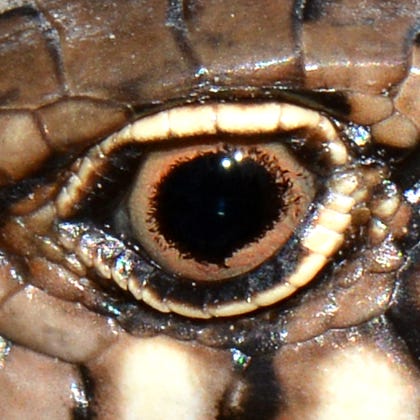
Whose Eye Was It?
The eye belongs to a bull skink. Photo credit: Jean and Fred Hort — Wikimedia Commons.
Thanks for reading. For past editions, see the Archive. If you found it interesting or useful, please share and subscribe. If you want to get in contact, you can reach me at: thenaturebeat@substack.com.
Take A Trip to Planet Ficus
My other newsletter Planet Ficus is devoted to stories about the world’s most fascinating plants — the strangler figs and their kin, which have shaped our world and our species in profound ways. Take a trip there for a rich mix of stories about the ecological and cultural importance of these trees.

