

Nature Beat #93
Updates, stories, resources and opportunities

Welcome to the latest edition of Global Nature Beat. This edition includes:
Updates on nature loss as a national security threat, the new State of Nature Finance report, Brazil’s biodiversity strategy, the EU-Mercosur trade deal, the High Seas Treaty.
Features about natural capital accounting, concerns about complicity of conservation NGOs in Indonesia, efforts to save the Great Barrier Reef, declining dugongs in Thailand, and African plant conservation.
Journal papers on urban trees and heart health, birds and fire, greening drylands, decarbonizing diets, snakes on trains, citizen wetland monitors, living wall biodiversity, and more.
Plus the usual mix of news from around the world, useful resources, jobs and opportunities for environmental journalists, and more.
Nature Loss Threatens National Security, Says Report UK Government Tried to Suppress
An official report the UK government tried to suppress set out how global biodiversity loss is now a serious threat to national security. In just 11 pages of clear text and graphics, it delivers stark warnings. “Every critical ecosystem is on a pathway to collapse,” it states, meaning “irreversible loss of function beyond repair”.
The report spells out the consequences of failing to stop this: More poverty, food insecurity and migration; increased pandemic risks; political instability and new opportunities for organized crime and terrorist groups to control scarce resources; and intensifying geopolitical competition, with rising risks of conflict within and between states.
None of this will surprise anyone who has been listening to the scientists documenting biodiversity loss and warning, with growing urgency, that it threatens humanity. As the report puts it: “All countries are exposed to the risks of ecosystem collapse within and beyond their borders.”
The assessment was prepared for the Joint Intelligence Committee, which oversees the British security services. Last October, Fiona Harvey and Helena Horton revealed that the government had blocked the report’s publication. The version published on 20 January — and only after a freedom of information request — is merely a summary. The full document remains secret.
This attempt at suppression echoes the Australian government’s refusal to publish an Office of National Intelligence assessment of national security threats posed by global heating. Such secrecy is reckless. Political support for addressing nature loss and climate change demands clear-eyed accounts of what is at stake.
By warning that disinformation will increase, the UK report also strengthen the case for broadcasters to televise a national emerging briefing on climate and nature.
Taking The Pulse
Nature finance: The UK report (above) makes a clear case for increasing investment in protecting and restoring nature worldwide. Yet, as the UN Environment Programme stated in a report released on 22 January, the world is spending 30 times more on activities that destroy nature than protect it — for details, see the story by Stuart Braun.
Brazil: Brazil published its overdue National Biodiversity Strategy and Action Plan. It was worth the wait. It includes a headline target of conserving 80 percent of the Brazilian Amazon rainforest, and 30 percent of other ecosystems, by 2030. This would exceed the target of the Global Biodiversity Framework. For more detail, see the analysis by Daisy Dunne and Giuliana Viglione, who looked at six parts of the plan and how Brazil aims to achieve its targets.
Trade: After 25 years of negotiations, officials from the European Union and the South American trade bloc Mercosur signed a free trade agreement on 17 January. The deal will create the world’s largest free trade area. But as Sam Meadows and Flávia Milhorance report, the agreement is ambiguous about environmental compliance and some academics say it could lead to an increase in deforestation and carbon emissions. On 21 January, the European Parliament forced a delay by referring the deal to the European Court of Justice to rule on its compatibility with EU treaties. Ultimately, the agreement must gain the consent of the European Parliament and be ratified by Argentina, Brazil, Paraguay and Uruguay before it can be implemented.
High seas: China has proposed hosting the secretariat for the High Seas Treaty on marine biodiversity in international waters, which entered into force on 17 January, reports Laura Zhou. By proposing Xiamen, a city in Fujian Province, China joins Belgium and Chile in hoping to host the secretariat. Parties to the agreement will decide among these options when they meet for the first time later this year. Rhett Ayers Butler (here) and Sandra Condon (here) have both written useful overviews of what the treaty entails and what is needed to ensure it is effective.
In The Spotlight
Kiley Price explored how economists and ecologists are developing natural capital accounting to quantify nature’s economic value and the financial risks of environmental degradation.
Arrum Harahap says some conservation organizations working in Indonesia risk becoming complicit in the degradation of local ecosystems.
Benji Jones wrote about Australia’s massive, high‑tech effort to keep the Great Barrier Reef alive through coral breeding and restoration.
Victor Nsereko Wantate argues that plant conservation in Africa is undermined by the vast number of species lacking recent — or any — status assessments, and calls for a new approach pairing global data with local field intelligence.
Gloria Dickie reported on the dramatic collapse of Thailand’s dugong population, tracing how seagrass die‑offs, pollution, climate‑driven stress and tourism pressures have harmed the species.
In Focus: Human-Wildlife Conflict
Three new stories published by Down To Earth highlight patterns of human-wildlife conflict in South Asia:
Leopard attacks in northern West Bengal, India are no longer seasonal and now take place year-round, reports Deepanwita Gita Niyogi. This is linked to growth in the leopard population and farmers shifting from rice to tea production — itself a response to elephant raids on rice farms.
In Nepal, bears have attacked maize farmer Dorje Dundul three times in the past five years, writes Geoff Childs, explaining how demographic trends contribute to a recent increase in such attacks in rural communities.
In the Indian section of the Sundarbans mangrove forest, there may be a gendered pattern to crocodile attacks — with most victims being women collecting prawns, report Aliya Bashir and Deepanwita Gita Niyogi.
Dispatch from Planet Ficus
At Planet Ficus, I wrote about how Indian ecologist Madhav Gadgil’s lifelong engagement with culturally and ecologically important fig trees shaped his radical, people‑centric vision for conservation, blending science, traditional knowledge and community rights to protect forests.

From The Journals
Urban trees may reduce cardiovascular disease but grassy areas may increase it — read the press release or the full paper.
Exposure of western United States bird communities to predicted high severity fire — read the full paper.
Intensive farming of açaí palms is bad for birds in the Brazilian Amazon — read the full paper.
Nearly 30 percent of global drylands got significantly greener since 2001, largely because of human activities — read the press release or the full paper.
Environmental impacts from European food consumption can be reduced with carbon pricing or reforms to value-added tax — read the press release or the full paper.
Accidental train journeys may be altering the distribution of king cobras and other snakes in southern India — read the full paper.
Well-designed living walls can deliver meaningful urban biodiversity benefits — read the press release or the full paper.
Citizen scientists should be at the core of monitoring wetland restoration — read the press release or the full paper.
Adding ‘Social’ to the European Union’s Green Deal could reinvigorate the flagging policy — read the full paper.
What Caught My Eye
Colombia’s deforestation rate declined again in 2025, reports Maxwell Radwin.
Warren Cornwall covered new research in which scientists say zoos risk becoming dysfunctional as their animals age and reproduce less.
As temperatures rise, penguins are breeding earlier and this is creating problems for two of the rarest species, reports Seth Borenstein.
The official Indonesian language dictionary has redefined oil palm as a tree — an editorial in Tempo argues that this could lead to more deforestation.
Low-cost ‘healthy’ diets could cut food-related carbon emissions by one-third, reports Yanine Quiroz.
The world is depleting freshwater faster than nature can replace it, pushing many regions into “water bankruptcy,” reports Bobby Bascomb.
David Akana interviewed Kenya’s environment minister Deborah Barasa about the country’s ambitious tree-planting goal of planting 15 billion trees by 2032.
The World Economic Forum launched the Forest Future Alliance to encourage investment in responsible forest conservation, restoration and stewardship.
Annie Roth reported on a promising new method for controlling invasive crown‑of‑thorns starfish that are devastating Indo‑Pacific coral reefs.
An ecologically significant seaweed “regime shift” may be underway in the ocean, reports Damien Gayle.
How to Support Global Nature Beat
I publish this newsletter as a free service to thousands of readers in more than 120 countries. If that is something you can support, please consider becoming a paying subscriber for less than £1 a week. If you can spare that, you will be helping me to keep Global Nature Beat going for those who cannot afford to pay.
Tips And Resources
Yessenia Funes wrote about how solutions‑focused journalism can empower readers, strengthen reporting, and highlight community‑driven responses to environmental crises.
The International Union for the Conservation of Nature published new ‘Explainer briefs’ on citizen science and a regenerative blue economy.
On 19 February, Covering Climate Now is running two training sessions on how journalists working various beats can add climate change angles to their coverage —register for 11am UK time or 6pm UK time.
An updated second edition of Story-Based Inquiry: A manual for investigative journalists by Mark Lee Hunter is now online for free download.
See past editions for more tips and resources.
Jobs And Opportunities
The Society of Environmental Journalists is offering travel stipends for its Annual Conference in Chicago — deadline 30 January.
Journalists in Europe can apply for a two-day training on investigative climate reporting — deadline 31 January.
The Association of British Science Writers invites entries for its 2026 awards — deadline 31 January.
The Tyee is hiring a biodiversity reporter based in British Columbia, Canada — deadline 8 February.
The Covering Climate Now Academy is offering free, live online training for journalists worldwide — deadline 16 February.
Nature is offering a paid, full-time science writing internship in one of its US offices — deadline 27 February.
The Earth Journalism Network has grants for stories on biodiversity in the Western Balkans — deadline 28 February.
WIRED is hiring a senior science editor — no deadline listed.
Mongabay is hiring a TikTok journalist (French) for Mongabay Africa.
The Council for the Advancement of Science Writing invites applications for its Taylor/Blakeslee Graduate Fellowships for graduate study in science journalism — deadline 16 March.
The Journalism Science Alliance has grants for collaborations between media and academia or research institutions — deadline 23 March.
The Council for the Advancement of Science Writing is accepting entries for the Sharon Begley Science Reporting Award — deadline 30 April — and the Evert Clark/Seth Payne Award for a young science journalist — deadline 30 June.
Bonus content: There are 43 jobs, grants, fellowships and other opportunities listed here for Global Nature Beat’s paying supporters. Paid subscriptions are less than £1 per week.
On The Horizon
3-8 February 2026: The 12th Plenary of the Intergovernmental Panel on Biodiversity and Ecosystem Services takes place in Manchester, United Kingdom.
7 February 2026: The Intergovernmental Negotiating Committee developing an international treaty on plastic pollution will meet in Geneva to elect a new chair of the negotiations.
14-16 February: The Corals, Coasts and One Health conference takes place in Saudi Arabia.
16-19 February: The UN Convention on Biological Diversity’s Subsidiary Body on Implementation meets in Rome, Italy.
Bonus content: The full calendar for Global Nature Beat’s supporters includes nature-related intergovernmental negotiations, scientific conferences, report launches, and other events up until 2026.
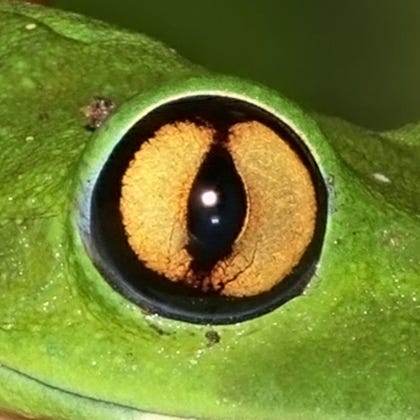
Whose Eye Was It?
The eye belongs to a golden-eyed tree frog. Photo credit: Charles J. Sharp — Wikimedia Commons.
.jpg)