

Nature Beat #91
Updates, stories, resources and opportunities

Welcome to the latest edition of Global Nature Beat. If you are new here, read my About page to find out what this newsletter is, who I am and why I am doing this. This edition includes:
Updates on President Trump’s retreat from global environmental action, and a packed year for treaty talks.
Features about rebounding species, wetland restoration, windfarms and migratory birds, falcon poaching, fortress conservation, megafires and birds.
Journal papers on trophy hunting perceptions, roads and deforestation, zoonotic disease, primate conservation, grapes versus chameleons, and more.
Plus the usual mix of news from around the world, useful resources, jobs and opportunities for environmental journalists, and more.
Taking The Pulse
Treaty talks: Global Nature Beat is back after a break and energized for what will be another packed year in the story of our species and its living planet. Multilateralism on environmental issues will be tested again, as 2026 is a ‘triple COP’ year — with conferences of parties to all three of the UN conventions agreed at the Earth Summit in Rio de Janeiro in 1992. In August, the 17th Conference of Parties to the UN Convention to Combat Desertification takes place in Ulaanbaatar, Mongolia. In October, the UN Biodiversity Conference (COP17) takes place in Yerevan, Armenia. And in November, the UN Climate Change Conference (COP31) will take place in Antalya, Turkey. This year will also have resumed negotiations towards a global treaty on plastic pollution. In March, Brazil will host the 15th Conference of Parties to the Convention on the Conservation of Migratory Species. And — next week — the high seas treaty on marine biodiversity enters into force. I’ll be tracking all of these and much more here at Global Nature Beat.
Trump: On 7 January, Donald Trump announced that the United States would withdraw from the UN Framework Convention on Climate Change (UNFCCC), the Intergovernmental Panel on Climate Change (IPCC) and other international bodies set up to respond to environmental challenges. His Presidential Memorandum explains that the decision is based on a report by Secretary of State Marco Rubio into US membership of organizations, treaties and so on that are “contrary to the interests of the United States”.
As well as the UNFCCC and IPCC, the list includes: the US-Canada-Mexico Commission for Environmental Cooperation; the UN Collaborative Programme on Reducing Emissions from Deforestation and Forest Degradation in Developing Countries (UN-REDD); the Intergovernmental Science-Policy Platform on Biodiversity and Ecosystem Services (IPBES); and the International Union for Conservation of Nature. To say that participating in and supporting efforts to understand and counter the threats of climate change and biodiversity loss is not in the interests of the United States is palpable nonsense.
In The Spotlight
Once-rare species are bouncing back on a Galapagos island cleared of invasive rats and cats, reported Sophie Hardach.
Xu Na wrote about the prospects for balancing China’s wind farm development with the needs of endangered migratory birds.
Annonciata Byukusenge and Freddie Clayton reported on efforts to restore wetlands across the Rwandan capital Kigali to reduce flood risks.
Oscar Nkala exposed how a former justice minister of Botswana secured a trophy hunting concession for an infamous South African hunter, sparking community unrest.
Gloria Dickie wrote about how California’s fire-adapted birds are faring as megafires become more frequent.
Soaring demand for elite racing and breeding falcons in the Middle East is driving the illegal capture of wild peregrines in the United Kingdom, reports Phoebe Weston.
Davide Lemmi and Marco Simoncelli wrote about how Tanzania’s creation of new game reserves is forcibly displacing Maasai communities.
From The Journals
What climate change means for mammals that hibernate — read the full paper.
German public perceptions of trophy hunting in sub-Saharan Africa — read the full paper.
Mechanized grape harvesting kills many chameleons in Israel — read the full paper.
Road expansion risk predicts future hotspots of tropical deforestation — read the full paper.
A bat-borne virus has been identified as the cause of an unexplained disease outbreak in Bangladesh — read the press release or the full paper.
The positive and negative roles of social media in primate conservation — read the full paper.
Only 59 percent of parties to the UN Convention on Biological Diversity included the contributions of traditional knowledge to biodiversity governance in their most recent national reports — read the full paper.
Nine sources of strain that drive environmental crime among communities living near a national park in Vietnam — read the full paper.
When long-term environmental data becomes a target, our ability to understand and respond to global change is profoundly compromised — read the press release or the full paper.
Take A Trip to Planet Ficus
My other newsletter Planet Ficus is devoted to stories about the world’s most fascinating plants — the strangler figs and their kin, which have shaped our world and our species in profound ways. Take a trip there for a rich mix of stories about the ecological and cultural importance of these trees.
What Caught My Eye
Joe Lo reports that Indian police have raided the homes and offices of climate activists, accusing them of jeopardizing India’s energy security by campaigning against fossil fuels.
Shimali Chauhan reports that the UN Convention on Biological Diversity’s official reporting system will no longer be restricted to governments, so that all sectors of society can provide information on actions contributing to the goals of the convention.
From 2018 to 2024, the proportion of UK media stories mentioning “net zero” that also referred to climate change or global warming fell from 90 percent to just 42 percent.
Stingless bees from the Amazon have become the first insects to be granted legal rights anywhere in the world, reports Damien Gayle.
Nearly half of Africa’s grasslands are grazed beyond their sustainable capacity, reports Musinguzi Blanshe.
Young Atlantic salmon have been seen in three English rivers for the first time in a decade, reports Hannah Al-Othman.
The European Union’s anti-deforestation law has been hollowed out, says the policymaker who drafted it.
Lucy Almond, chair of the Nature4Climate coalition, shared four predictions for 2026 about investments in nature-based solutions to climate change.
The Earth Journalism Network shared 19 solutions-based climate and environmental stories by journalists it supported in the Asia-Pacific region.
Ronald Musoke wrote about how African policymakers, scientists and community leaders recently met to design a continent‑wide, transboundary conservation programme aimed at strengthening ecosystem connectivity and resilience.
How to Support Global Nature Beat
I publish this newsletter as a free service to thousands of readers in more than 120 countries. If that is something you can support, please consider becoming a paying subscriber for less than £1 a week. If you can spare that, you will be helping me to keep Global Nature Beat going for those who cannot afford to pay.
Tips And Resources
The International Union for the Conservation of Nature published a briefing paper on the “state of play” for crimes affecting the environment.
Anna Napolitano wrote an explainer on the latest science on ocean acidification and why it matters.
The UN Environment Programme published a quick guide to the National Biodiversity Strategies and Action Plans that parties to the UN Convention on Biological Diversity develop and implement.
The European Federation for Science Journalism published reporting guides for journalists in Bulgaria and Turkey.
Scientists published a global compendium of nature-based solutions on small and medium-sized islands.
See past editions for more tips and resources.
Jobs And Opportunities
The Solutions Journalism Network seeks consultants in India and Brazil for two-year contracts — deadline 19 January.
Resilience.org is hiring a managing editor — deadline 21 January.
The Fund for Investigative Journalism is offering grants of up to US$10,000 — deadline 30 January.
Carbon Pulse is hiring an Asia-Pacific Environmental Markets Correspondent and a Toronto/Vancouver-based Environmental Markets Correspondent — deadline 31 January.
Bonus content: There are 34 jobs, grants, fellowships and other opportunities listed here for Global Nature Beat’s paying supporters. Paid subscriptions are less than £1 per week.
On The Horizon
19-23 January: The World Economic Forum’s annual meeting takes place in Davos, Switzerland.
3-8 February 2026: The 12th Plenary of the Intergovernmental Panel on Biodiversity and Ecosystem Services takes place in Manchester, United Kingdom.
7 February 2026: The Intergovernmental Negotiating Committee developing an international treaty on plastic pollution will meet in Geneva to elect a new chair of the negotiations.
16-19 February: The UN Convention on Biological Diversity’s Subsidiary Body on Implementation meets in Rome, Italy.
Bonus content: The full calendar for Global Nature Beat’s supporters includes nature-related intergovernmental negotiations, scientific conferences, report launches, and other events up until 2026.
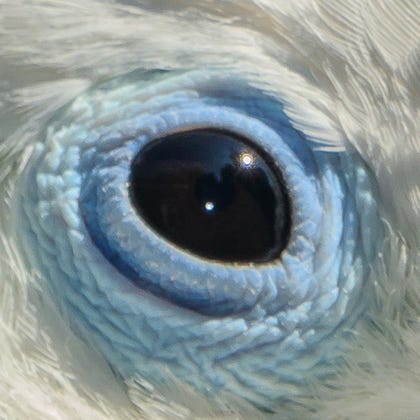
Whose Eye Was It?
The eye belongs to a northern sulphur-crested cockatoo. Photo credit: H. Zell — Wikimedia Commons.

Thanks for reading. For past editions, see the Archive. If you found it interesting or useful, please share and subscribe. If you want to get in contact, you can reach me at: thenaturebeat@substack.com.
Really appreciate this roundup format, especially the calendar tracking the triple COP year. The Ulaanbaatar desertification conference timing is intresting since Mongolia itself is battling extensive land degradation from overgrazing and climate shifts. I worked with a similar regional body covering arid zones and these international frameworks often struggle to translate broad commitments into ground-level restoration actios. Curious if the COP17 proceedings will spotlight any local sucess stories beyond the usual policy chatter.