

Nature Beat #89
Updates, stories, resources and opportunities

Welcome to the latest edition of Global Nature Beat. If you are new here, read my About page to find out what this newsletter is, who I am and why I am doing this. Or just dive in. This edition includes:
Updates on the annual Operation Thunder busts of wildlife traffickers, a fractious UN Environment Assembly, a thwarted report on problems and solutions, the 30x30 target of the Global Biodiversity Framework, and what experts think is on the horizon.
Features on human impacts of vulture declines in India, wildlife crossings in the United States, the difficult return of bald ibises to Europe, and regulated trade in endangered species.
Journal papers on streetlights versus pollinators, shifts in the global illegal wildlife trade network, improving marine conservation, Facebook spotting invasive species, and a common forest restoration method debunked?
Plus the usual mix of news from around the world, useful resources, jobs and opportunities for environmental journalists, and more.
Taking The Pulse
Operation Thunder: The annual coordinated operation against wildlife trafficking led by INTERPOL and the World Customs Organization always reveals much about the scale of the illegal wildlife trade and the diversity of species involved. In this year’s Operation Thunder, law enforcement agencies in 134 countries seized nearly 30,000 live animals in a single month. This included more than 200 primates, 6,000 birds and 10 big cats. Also seized were 1,900 pieces of ivory, 7 tons of pangolin scales and meat, 830 bear parts and more than 10,000 spiders and insects — see the press release for details. Operation Thunder took place between 15 September and 15 October, and was made public on 11 December.
UNEA-7: The world’s top environmental decision-making body — the UN Environment Assembly — ended on 12 December, having adopted 11 resolutions to boost global action on coral reefs, waste management, sustainable use of artificial intelligence, wildfires, invasive seaweed and glaciers, among other issues. Four other resolutions — including on deep-sea mining and crimes that affect the environment — were dropped from the agenda as governments could not agree on them. The Assembly also approved a new four-year strategy and two-year programme of work for the UN Environment Programme (UNEP). The European Commission and UNEP say these results show that multilateralism still works. But the meeting was fractious — with the United States withdrawing from the negotiations and disassociating itself from all of the meeting’s outcomes. For more details, see the Earth Negotiations Bulletin’s detailed summary.
GEO-7: UNEP released the 7th edition of its Global Environmental Outlook report, which calls for integrated policies and a rapid transition away from fossil fuels to address the linked challenges of climate change, biodiversity loss and pollution. Nearly 300 scientists from 82 countries contributed to the report. They say investing in planetary health now will bring big dividends: ending poverty and hunger for hundreds of millions of people, preventing millions of early deaths and adding trillions of dollars to global GDP — see the press release. Previous editions of the report have been endorsed by all governments at the UN Environment Assembly. But not this time. A small number of countries including the Russia, Saudi Arabia and the United States refused to approve the summary of key findings and recommendations, leaving it unpublished. “A small number of countries basically just hijacked the process, to be quite honest,” the report’s co-chair Sir Robert Watson told BBC News.
Predictions: It’s crystal ball time. Scientists have published an annual scan of emerging issues that could shape efforts to conserve our planet’s biodiversity — from the impacts of appetite-supressing drugs on land use, to changes in how much light penetrates the ocean, and prospects for low-power, low-cost monitoring tools using artificial intelligence. In the United States, Joseph A Davis took a look at the issues likely to keep environmental journalists there busy next year. And on 15 December, the Global Catastrophic Risks Report 2026 was published. It considers five big risks facing us — climate change, biodiversity collapse, weapons of mass destruction, artificial intelligence in military decision-making and near-Earth asteroids. Heavy stuff, but stuff we must face.
30x30: Most of the world’s countries have committed to protect 30 percent of land and sea areas by 2030 — it is the headline-grabbing target of the Global Biodiversity Framework that parties to the UN Convention on Biological Diversity agreed in 2022. But according to a new report and interactive dashboard, despite a recent surge in funding, the annual total is about US$4 billion short of what is needed to achieve this 30x30 target — see the press release. As Maina Waruru reports, Africa has received the largest share of finance, getting nearly half of all international funding for protected and conserved areas. Money is not the only limiting factor — deciding where and how to protect is also key. A new report from the World Bank provides country-level pathways for achieving the 30x30 target in ways that prioritize cost-effective species conservation.
In The Spotlight
Tracy Keeling’s write-up of the recent conference of parties to the Convention on International Trade in Endangered Species is the best I have seen.
Marta Abbà wrote about the return to Europe of the northern bald ibis — 400 years after it went extinct there — and the threats the species faces from poaching in Italy and collisions with power lines.
Mark Johnson and Saumya Khandelwal reported on the human costs of one of the most rapid declines in wildlife — the 100-fold decline in vulture numbers in India.
Ben Goldfarb wrote about how wildlife crossings — from bridges for mountain lions to tunnels for tarantulas — are playing critical roles in conserving biodiversity.
Sumatra’s ‘natural’ disaster wasn’t natural, writes Rhett Ayers Butler.
From The Journals
Trade-offs and expected benefits of reducing pesticide use in agriculture worldwide— read the press release or the full paper.
Streetlights mess with the timing of plant flowering, with possible knock-on effects for pollinators and herbivores — read the full paper.
Analysis of Facebook posts greatly increases data on invasive species in Bangladesh — read the full paper.
A review of evidence on the increasingly popular Miyawaki method of forest restoration found no well documented benefits — read the full paper.
Five opportunities to make area-based marine conservation more effective — read the full paper.
Seven principles for reforming biodiversity governance to boost conservation, agriculture and food security — read the full paper.
Two decades of changes in the global network of illegal wildlife trade — read the full paper.
There are around 2,500 species of edible plants in the Mediterranean region — read the full paper.
Take A Trip to Planet Ficus
My other newsletter Planet Ficus is devoted to stories about the world’s most fascinating plants — the strangler figs and their kin, which have shaped our world and our species in profound ways. Take a trip there for a rich mix of stories about the ecological and cultural importance of these trees.
What Caught My Eye
The iconic snowy owl is now extinct in Sweden — BirdLife International blames declines in their rodent prey caused, in turn, by the warming climate.
India’s largest renewable energy company, Adani Green Energy, has pledged to ensure its operations cause no net loss of biodiversity by 2030, and announced plans to plant 28 million trees.
Brazil launched its new five-year National Biodiversity Strategy and Action Plan, which includes goals of conserving 80 percent of the Amazon and restoring 30 percent of degraded areas of all biomes by 2030 — see the official press release and report links in Portuguese or a brief overview in English.
Environmental news site Mongabay has launched a wildlife desk.
South Africa launched its fourth National Biodiversity Assessment — see the press release.
Suzano, the world’s largest producer of pulp and paper, launched its Nature Strategy, which includes action to conserve 24 of the 125 endangered species in territories where it operates.
The Bezos Earth Fund announced US$24.5 million in grants for marine conservation projects in Costa Rica, Panama, Colombia and Ecuador.
The Indonesia government has ordered dozens of oil palm and mining companies to pay fines totalling US$2.3 billion for operating illegally in forest areas.
Rwanda and Uganda are developing policies to recognize community-led initiatives that conserve biodiversity in parallel to traditional protected areas, reports Eric Twahirwa.
Otters have made a remarkable recovery in the rivers of the United Kingdom, reports Patrick Greenfield.
What are countries doing for their forest biodiversity? A new study examines how countries are including forests in their national biodiversity strategies and action plans.
Stop Ecocide International welcomes a new policy on environmental damage issued by the International Criminal Court’s Office of the Prosecutor — saying it signals “a marked shift in how international justice will engage with ecological harm”.
Environmental journalism is becoming a high-risk field but professional safeguards have not evolved accordingly, writes Marta Castillo Sánchez.
If the world feels like it is going to hell, read David Akana’s interview of Wanjira Mathai of the World Resources Institute for some upbeat analysis, as well as reflections on the legacy of her mother —the Nobel laureate Wangari Maathai.
Astrid Peraza and Baruch Aguilar Mena wrote about their hopes for the Escazú Agreement — the newish international treaty that aims to ensure public access to environmental information and participation in environmental decision making across Latin America and the Caribbean.
How to Support Global Nature Beat
I publish this newsletter as a free service to thousands of readers in more than 120 countries. If that is something you can support, please consider becoming a paying subscriber for less than £1 a week. If you can spare that, you will be helping me to keep Global Nature Beat going for those who cannot afford to pay.
Tips And Resources
TED’s climate editor Gulnaz Khan shared her tips on making the leap from writing to visual storytelling.
The Secretariat of the Convention on International Trade in Endangered Species of Wild Fauna and Flora (CITES) launched two online courses on how the convention works.
The Balkan Network of Science Journalists published a new reporting guide for journalists in Bulgaria.
See past editions for more tips and resources.
Jobs And Opportunities
The Agroecology Fund is hiring a consultant communications specialist — deadline 15 January.
The Earth Journalism Network has story grants for journalists covering transparency in fisheries management — deadline 15 January.
Lighthouse Reports is hiring a part-time open-source intelligence fellow — deadline 2 January 2026.
The Earth Journalism Network is offering reporting fellowships to support journalists in the Philippines to cover climate-related disasters, adaptation measures and government preparedness — deadline 9 January.
The Marine Biological Laboratory in Woods Hole, United States is hiring a science writer / editor — no deadline listed.
Mongabay is hiring a copy editor — rolling deadline.
The Canadian Journalism Foundation’s award for climate solutions reporting is open for entries deadline 23 January 2026.
Journalists in Europe and Africa can apply for six-months of remote training on advanced investigative tools for reporting on environmental issues linked to global supply chains — deadline 20 December.
Internews’s Earth Journalism Network is hiring a project director and an Africa coordinator for its new Forest Governance Media Initiative.
Bonus content: There are 38 jobs, grants, fellowships and other opportunities listed here for Global Nature Beat’s paying supporters. Paid subscriptions are less than £1 per week.
On The Horizon
19-23 January: The World Economic Forum’s annual meeting takes place in Davos, Switzerland.
3-8 February 2026: The 12th Plenary of the Intergovernmental Panel on Biodiversity and Ecosystem Services takes place in Manchester, United Kingdom.
16-19 February: The UN Convention on Biological Diversity’s Subsidiary Body on Implementation meets in Rome, Italy.
23-29 March 2026: The 15th Conference of Parties to the Convention on Migratory Species takes place in Campo Grande, Brazil.
Bonus content: The full calendar for Global Nature Beat’s supporters includes nature-related intergovernmental negotiations, scientific conferences, report launches, and other events up until 2026.
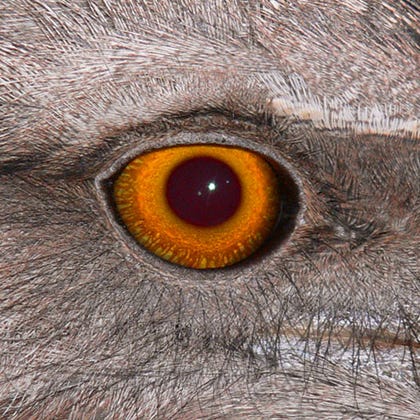
Whose Eye Was It?
The eye belongs to a tawny frogmouth. Photo credit: Benjamint444 — Wikimedia Commons.

Thanks for reading. For past editions, see the Archive. If you found it interesting or useful, please share and subscribe. If you want to get in contact, you can reach me at: thenaturebeat@substack.com.