

Nature Beat #114
Updates, stories, resources and opportunities

Welcome to the latest edition of Global Nature Beat. This edition includes:
Updates on killer heat and the media, keystone corporations, harm to the US Endangered Species Act, 30x30 in the UK, the EU Deforestation Regulation, trade in endangered species, national environmental performance rankings.
Features about songbird trade in Indonesia, ecological grief, health benefits of nature, illegal wildlife trade in Canada, nature-positive conservation and China’s battle against desertification.
Journal papers on biodiversity monitoring in small island states, forest fragments in Mexico’s cattle pastures, extinction-risk footprints of financial institutions, invasive mantises, tree diversity and forest climate resilience, coexistence with tigers, Red List assessments and climate risk, and more.
Plus, the usual mix of news from around the world, useful resources, jobs and opportunities for environmental journalists, and more.
Taking The Pulse
Keystone corporations: In a new study, researchers identified 180 ‘keystone corporations’ that have the greatest influence over the state of the biosphere. While 79 percent of these companies have made some kind of pledge related to biodiversity, only 13 percent have reported on their commitments with sufficient detail and transparency to enable others to assess their claims. The authors suggest ways to improve corporate accountability through better biodiversity target setting and reporting.
Heat: The recent heatwaves in Europe killed more than 10,000 people and were made more likely by global heating caused by greenhouse gas emissions, but too many journalists have failed to make this link clear. As Fiona Harvey reports, an analysis of 2,700 articles by nine national media outlets in the United Kingdom showed that 72 percent of them did not mention global heating or climate change.
Environmental rankings: Yale University’s biennial Environmental Performance Index was published on 8 July. The index ranks 177 countries on 47 indicators across 12 issue categories spanning environmental health, ecosystem vitality and climate change. As Oliver Milman reports, despite widespread progress on pollution, action on climate change is lagging. The top three ranked countries, in order, are Estonia, Luxembourg and the United Kingdom. The bottom three: Bangladesh, India and Laos. European countries occupy all but two of the top 25 places — and are joined there by Japan and Australia. See also Aathira Perinchery’s reporting on India’s performance.
Harm: On 10 July, the Trump administration rescinded the definition of “harm” under the Endangered Species Act to exclude habitat destruction. As ecologist Mariah Meek and law professor Karrigan Börk explain, this effectively guts the Endangered Species Act’s core protections. In a press release, the Center for Biological Diversity called the rescission of the harm definition “a cynical attempt to open species’ habitats to logging, mining, oil and gas drilling and other destruction.” On 14 July, it joined other environmental organizations in suing the Trump administration in an attempt to block the move, which it says is illegal.
Deforestation: The European Commission published its final changes to the list of products to be covered by the EU Deforestation Regulation when it enters into application on 31 December. Importers of such products must show that they were not produced on recently deforested land. Leather is no longer included in the final list, despite being linked to around 39,000 hectares of deforestation every year, according to the Commission’s own ‘staff working document’. “Leather’s exclusion will keep European consumers complicit in environmental and human rights abuses,” said non-profit organization Earthsight in a press release. See also, reactions from Mighty Earth and Rainforest Foundation Norway.
Wildlife trade: The 34th meeting of the Animals Committee of the Convention on Trade in Endangered Species (CITES) is underway in Geneva, Switzerland— see the press release. From 17 July, the Plants Committee will meet, focusing on issues related to the sustainable management and trade of species including rosewood trees, orchids and medicinal plants — see the press release.
30x30: Four years after committing to conserve 30 percent of its land and sea by 2030, the UK government has published its plan for achieving this target — see the press release. As Pippa Neill and Sandra Laville report, environmental organizations are dismayed, particularly by the plan’s reliance on voluntary actions by landowners. Writing on LinkedIn, Richard Benwell, chief executive at Wildlife and Countryside Link said: “If the 30 by 30 plan published today had been published in 2022 on the day of the global biodiversity agreement it would have looked like leadership. Right now, it looks like too little, too late.”
In The Spotlight
Katarina Zimmer spoke with neuroscientists and environmental psychologists about how nature reduces pain, eases stress, inspires creativity and boosts our immune systems.
Sandy Ong wrote about high‑stakes bird‑singing contests in Indonesia that are driving rampant trapping and pushing songbirds toward extinction.
Olivia Zhang reported on China’s decades‑long battle against desertification using vast “straw checkerboard” grids.
Jenn Thornhill Verma wrote about how Canada’s booming illegal wildlife trade is increasingly entwined with organized criminal networks.
“Each time I pass the rookery, I feel an ache that does not seem entirely polite to share” — Megan Mayhew Bergman wrote about collective suppression of ecological grief and a need for shared language and rituals. “Let’s call it earth grief,” suggests Stephanie Klotz.
John Cannon wrote about scientists promoting a nature-positive framework that tracks ecosystem health — rather than just counting species — to halt and reverse biodiversity loss.
From The Journals
Small island developing states face outsized challenges to monitoring their progress under the Global Biodiversity Framework — read the full paper.
The ecological and conservation value of forest fragments within cattle ranching landscapes in Mexico — read the full paper.
Trade-induced extinction-risk footprints of European financial institutions — read the full paper.
Invasive mantises from Asia are threatening species in Europe — read the press release or the full paper.
Higher tree diversity consistently improves resistance and recovery of US forests under both individual and compound climate extremes — read the full paper.
Coexistence with tigers requires social‑science solutions that reduce risk, support livelihoods and strengthen community tolerance — read the full paper.
Seagrass meadows in East Africa support more nutritious fisheries than nearby coral reefs — read the press release or the full paper.
Models used for Red List assessments underestimate climate-related extinction risk of range-shifting species — read the press release or the full paper.
What Caught My Eye
A new ClientEarth report compares how Finland, France and Poland use the law to bring their rivers back to life — as the press release notes, “the results could hardly be more different”.
Meaghan Cuddy says global ocean commitments show strong ambition but urgently need faster, better‑funded implementation.
Global warming is increasingly pushing tropical forests beyond heat thresholds that halt photosynthesis and carbon uptake, reports Himanshu Nitnaware.
Subhra Priyadarshini interviewed science and environment journalists in India about the challenges of countering fast‑spreading misinformation.
The new update to the All-Ireland Pollinator Plan — launched on 9 July — envisions creating patches of pollinator habitat providing food and shelter every 200 metres by 2030.
Survival International reports that police in India arrested Indigenous rights activist Pranab Doley and two other men for protesting against conservation-related human rights abuses.
Cambodia’s tiger‑return plan is pitched as ecological and economic revival but faces concerns over prey, habitat and safety.
The Society for Conservation Biology’s North American section has updated its definition of conservation to address long‑standing divides over ethics and practice, reports Michelle Nijhuis.
The Trump administrator has appointed Matthew Wielicki — who has said that people who believe in climate science are “being sold snake oil” — to oversee the federal government’s national report on climate impacts.
Diane Taylore wrote about UK nature charities and asylum seekers restoring habitats together.
Private capital labelled ‘nature finance’ mostly funds agriculture and natural‑asset businesses rather than true ecological outcomes, writes Theresa Lieb.
Strict legal protections are failing to reverse the decline of caviar-producing sturgeons in Bulgaria, Romania and Ukraine, reports Marian Chiriac.
How to Support Global Nature Beat
I publish this newsletter as a free service to thousands of readers in more than 120 countries. If that is something you can support, please consider becoming a paying subscriber for less than £1 a week. If you can spare that, you will be helping me to keep Global Nature Beat going for those who cannot afford to pay.
Tips And Resources
The Earth Journalism Network asked me to write a tipsheet for journalists about conservation beyond protected areas, in what are known as OECMs (other effective area-based conservation measures) — also available as a PDF.
RECOFTC’s free Community Forestry 101 e-course is open for enrolment.
Want to know how environmental journalism works? Join Mongabay’s webinar on 21 July.
The International Union for the Conservation of Nature published its position paper ahead of next month’s conference of parties to the UN Convention to Combat Desertification.
Mongabay-India’s senior production editor Aditi Tandon wrote about why precise source attribution strengthens environmental journalism and helps readers assess expertise.
See past editions for more tips and resources.
Jobs And Opportunities
CalMatters and Grist seek a reporter to cover the impacts of climate change in California’s Central Valley — no deadline listed.
The Santa Fe New Mexican is hiring an environment reporter — no deadline listed.
The Telegraph is hiring a science correspondent — no deadline listed.
The Australian Broadcasting Corporation invites emerging media leaders in Southeast Asia to join the Future Voices program on climate change journalism — deadline 25 July.
Dialogue Earth is offering US$1,500 for photo stories and socials-first stories on heat solutions in the Global South — deadline 31 July.
Media for Environment, Science, Health and Agriculture (MESHA) invites newsrooms in Anglophone Africa to apply to join a new initiative aimed at strengthening climate solutions reporting — deadline 31 July.
The Earth Journalism Network has grants for newsrooms and media organizations in coastal countries, especially Ghana, Mexico and the Philippines, to support projects that boost coverage of the global 30x30 marine conservation target — deadline 10 August.
The Financial Times is hiring a senior reporter for its Sustainable Views publication— no deadline listed.
Applications are now open for the next Covering Climate Now Academy, providing live online training for journalists worldwide — deadline 11 August.
In October, the Earth Journalism Network is holding a two-day virtual media workshop on forest governance, primarily for journalists from Ghana, Liberia and Cameroon, though applicants from forest-risk commodity consumer markets in Europe and Asia are also welcome — deadline 13 August.
Bonus content: There are 40 jobs, grants, fellowships and other opportunities listed here for Global Nature Beat’s paying supporters. Paid subscriptions are less than £1 per week.
On The Horizon
27 July - 1 August: The 28th Meeting of the CBD Subsidiary Body on Scientific, Technical and Technological Advice takes place in Nairobi, Kenya.
4-12 August: The 7th Meeting of the CBD Subsidiary Body on Implementation takes place in Nairobi, Kenya.
17-28 August 2026: The 17th Conference of Parties to the UN Convention to Combat Desertification takes place in Ulaanbaatar, Mongolia.
11 September: BirdLife International will host its second Global Flyways Summit in Nairobi, Kenya.
Bonus content: The full calendar for Global Nature Beat’s supporters includes nature-related intergovernmental negotiations, scientific conferences, report launches, and other events up until 2029.
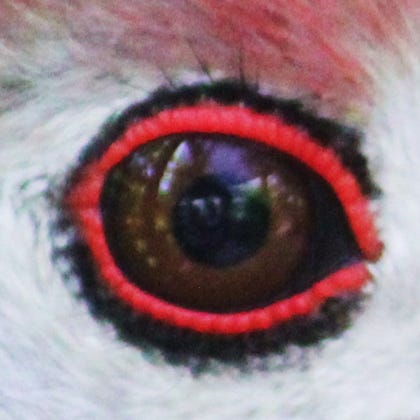
Whose Eye Was It?
The eye belongs to a red-crested turaco. Photo credit: Frostdragon — Flickr/Creative Commons.
Thanks for reading. For past editions, see the Archive. If you found it interesting or useful, please share and subscribe. If you want to get in contact, you can reach me at: thenaturebeat@substack.com.
Take A Trip to Planet Ficus
My other newsletter Planet Ficus is devoted to stories about the world’s most fascinating plants — the strangler figs and their kin, which have shaped our world and our species in profound ways. Over the past year, I’ve taken readers to rainforest canopies and city streets, explored ancient scriptures and modern science, and followed threads that connect ecology and culture around the world. If that sounds interesting, you can subscribe here or check out my selection of top stories published so far.
Your posts document the world as it slowly is throttled to death. I'm sure you would prefer the opposite, as the world is slowly rebuilt. Either way, I feel it is a serious spiritual act to read and consider it all. Thank you for underwriting this ritual.
Thank you for all the information!