

Nature Beat #113
Updates, stories, resources and opportunities

Welcome to the latest edition of Global Nature Beat. This edition includes:
Updates on the Sustainable Development Goals, trade in endangered species, mixed fortunes of whale species, logging in the Congo basin, nature and security risks.
Features about invasive fish in Thailand, community-led reef recovery in Mexico, the UK’s lost dawn chorus, anti-poaching tech in Vietnam, unregulated mining in Myanmar, how to save Nigeria’s vanishing vultures.
Journal papers on nature-positive tourism, urban forests as essential infrastructure, sustainable reptile harvesting for the skin trade, songbirds as pollinators, legal aspects of bison rewilding, Amazonian biocultural heritage, nature-based mental healthcare, and more.
Plus, the usual mix of news from around the world, useful resources, jobs and opportunities for environmental journalists, and more.
Taking The Pulse
SDGs: On 7 July, the UN released its annual assessment of progress towards the Sustainable Development Goals whose 2030 deadline is looming. The report notes that despite many significant results, progress is uneven and insufficient. It calls for urgent action to scale up efforts to meet the goals — see the press release or the full report. Global Nature Beat readers may be particularly interested in the overviews of progress for Goal 13 on climate action, Goal 14 on life below water and Goal 15 on life on land.
Asia-Pacific: On 3 July, governments across Asia and the Pacific agreed to coordinate action to tackle climate change, biodiversity loss and pollution. The decision came in a ministerial declaration and a programme of action, which were both adopted at a meeting convened by the UN Economic and Social Commission for Asia and the Pacific (ESCAP). The plans focus on increasing alignment of policies between sectors. Earlier in the week, ESCAP published a report based on 140 case studies showing how countries can achieve such alignment.
Wildlife trade: On 13-17 July, the 34th meeting of the Animals Committee of the Convention on Trade in Endangered Species (CITES) will take place in Geneva, Switzerland. The committee exists to advance animal-related scientific and technical work that strengthens the implementation of CITES. Delegates will focus on issues related to the sustainable management and trade of species including corals, sharks and rays, eels, big cats, vultures, and amphibians — see the press release.
Whales: Some good news for whales in two recent stories… David Brown reports increased sightings of blue and fin whales off southern Africa, while Diarlei Rodrigues and Eléonore Hughes report that humpback whale numbers are booming off Rio de Janeiro, Brazil. Both stories suggest the whale populations are recovering from the devastation wreaked by whaling. But other species are suffering. Vauhini Vara reports that climate‑driven food shortages are starving gray whales, pushing the population toward potential collapse. Her opening line: “I had been at the San Ignacio Lagoon no longer than fifteen minutes when I learned that another gray whale had washed up dead.”
DRC: A coalition of 70 organisations has issued a joint letter to the Prime Minister of the Democratic Republic of Congo (DRC), urging the government to maintain a 23-year-old moratorium on the allocation of new industrial logging concessions. They say plans to end the moratorium would undermine climate action and forest governance reforms, putting large areas of forest at risk of unsustainable exploitation. Read the press release, the coalition’s letter to the Prime Minister of the DRC and the associated briefing paper. For a counterpoint, see Claudia Geib’s story on research suggesting that expanding logging concessions could help the Congo Basin store more carbon while creating local employment.
Security: The UK government is resisting publishing the full version of a report on national security risks from collapsing ecosystems worldwide — a shorter version was released back in January only after freedom-of-information requests. The UK parliament’s environmental audit committee has now called for the full report to be published, reports Fiona Harvey. Committee member Christopher Hinchliff, a Labour MP, said: “The government can summon billions of pounds for new military hardware when the defence sector calls for it. We need an equally decisive mobilisation of investment to restore the natural world on which we rely for our food, water, and clean air. Without these essentials our country has no future.”
In The Spotlight
Tom Fawthrop reports that unregulated mining in Myanmar is poisoning tributaries of the Mekong River, threatening ecological and human health and food security across the region.
Kingsley Charles interviewed ornithologist Michael Manja Williams about his efforts to challenge harmful cultural beliefs threatening Nigeria’s critically endangered vultures.
Sandra Laville and Madeleine Finlay take us back in time 50 years to hear what the dawn chorus sounded like when Britain had 73 million more birds than it does today.
Erik Olsen wrote about how community‑led no‑take protection sparked one of the world’s most dramatic reef recoveries, in Cabo Pulmo, Mexico.
Rebecca Ratcliffe reports that the invasive blackchin tilapia is devastating Thai fisheries and overwhelming native ecosystems.
Campbell Rusden interviewed members of an antipoaching unit in Vietnam using tech‑driven patrols to cut wildlife crime.
From The Journals
So-called nature-positive tourism should prioritize biodiversity conservation over other environmental issues — read the full paper.
Public investment in parks, education and transport is essential to scale-up and harness the benefits of nature‑based mental healthcare — read the press release or the full paper.
Policy reforms are needed to recognize urban forests as essential infrastructure for climate resilience, biodiversity and public health — read the press release or the full paper.
Five key frontiers in nature-based insurance — read the full paper.
Reptile harvesting for the skin trade appears to be biologically sustainable in the vast majority of cases — read the full paper.
UK songbirds play roles as pollinators especially when insect prey is scarce — read the press release or the full paper.
The legal dimensions of reintroducing European bison to Sweden —read the full paper.
Amazonian biocultural heritage is highly vulnerable to climate change and the loss of Indigenous languages — read the press release or the full paper.
The words and tone US media outlets use when covering species extinction and endangerment — read the full paper.
What Caught My Eye
Eleven environmental organisations have launched a coalition to hold EU member states legally accountable for allowing destructive fishing inside marine protected areas, reports Rob Hutchins.
The Global Environment Facility published its twice-yearly scorecard measuring progress towards its targets on biodiversity, carbon emissions, land management and restoration, transboundary water management, chemicals and waste.
Giving rivers legal rights is not enough to protect them from pollution, says a new report from the Stockholm Environment Institute.
IUCN published a legal brief on how to give prominence to ecosystems, biodiversity and human health in the Global Plastics Treaty.
Thirteen UK environmental organisations have set six tests for incoming prime minister.
Aruna Chandrasekhar and Molly Lempriere examine where the six candidates to replace António Guterres as UN Secretary General stand on climate change.
IUCN published the latest update to its Red List of endangered species.
Aathira Perinchery wrote about a new report highlighting India’s booming exotic pet trade, regulatory gaps and rising biosecurity risks.
Nima Shokri says Iran’s long‑ignored ecological collapse is crippling its economy and demands urgent restoration.
The UN Environment Programme published an interview with Astrid Shomaker, head of the Convention on Biological Diversity, about how this year’s COP17 biodiversity conference will address issues related to finance.
IUCN published its position paper ahead of the forthcoming meetings of the CBD’s subsidiary bodies taking place from 27 July to 1 August in Nairobi.
Global Forest Watch is becoming Global Nature Watch.
Sara Solomon reports that, after a 15-year delay, Ethiopia will finally release to communities funds generated from companies accessing the country’s genetic resources.
Indonesia is developing a plan to protect local wisdom in biodiversity conservation, reports Hans Nicholas Jong.
Jackson Ryan argues that formulaic single‑study reporting and newsroom incentives are eroding meaningful science journalism.
How to Support Global Nature Beat
I publish this newsletter as a free service to thousands of readers in more than 120 countries. If that is something you can support, please consider becoming a paying subscriber for less than £1 a week. If you can spare that, you will be helping me to keep Global Nature Beat going for those who cannot afford to pay.
In Focus: App-based Citizen Science
Eden Flaherty wrote about how citizen science smartphone apps — such as Merlin, eBird and iNaturalist — are transforming biodiversity research by enabling vast, validated global observations.
For an example, see Bibek Bhandari’s story about how members of Nepal’s growing birdwatching community are using eBird to boost conservation data.
Sandra Laville reports that Merlin’s birdsong detections will soon feed directly into eBird to strengthen global monitoring.
Tips And Resources
Climate Tracker Asia and Climate Interactive are inviting journalists, advocates and communicators in South and Southeast Asia to join a free interactive masterclass on using the En-ROADS tool to test climate solutions and tell better climate stories — register here.
The Earth Journalism Network published a tipsheet on reporting on marine protection in Ghana.
On 13 July, EurekAlert has a webinar on how journalists can evaluate scientific research — register here.
The Geneva Environment Network updated its guide to the ‘rights of nature’ legal concept and the UK Parliamentary Office of Science and Technology published a ‘rapid response’ briefing on the same topic.
Oxpeckers Investigative Environmental Journalism has launched a newsletter — subscribe here.
West African Journalists for Environment, Science, Health & Agriculture launched its new website.
On 12 August, Covering Climate Now is running an online training session on the ‘three pillars’ approach to climate change journalism: ‘humanize, localize, solutionize’ — register here.
Pierre Leibovici — environment editor at Disclose — shared six tips journalists can use to increase the impact of their reporting.
See past editions for more tips and resources.
Jobs And Opportunities
The Solutions Journalism Network is running a Train-the-Trainers program for journalists in India — deadline 15 July.
The Earth Journalism Network has story grants for Thai journalists interested in covering the relationship between business and climate change — deadline 19 July.
Dynah Rochmyaningsih is offering free online training in science journalism to a small number of Indonesian journalists — apply here by 31 July.
New Scientist is hiring a data journalist — no deadline listed.
The Thomson Foundation’s Young Journalist Award 2026 is open for entries — deadline 9 August.
Bonus content: There are 35 jobs, grants, fellowships and other opportunities listed here for Global Nature Beat’s paying supporters. Paid subscriptions are less than £1 per week.
On The Horizon
13-31 July: The meeting of the International Seabed Authority assembly and council takes place in Kingston, Jamaica
13-16 July: The 34th meeting of the Convention on International Trade in Endangered Species (CITES) Animals Committee takes place.
17 July: A joint session of the Convention on International Trade in Endangered Species (CITES) Animals and Plants Committees takes place.
20-23 July: The 28th meeting of Convention on International Trade in Endangered Species (CITES) Plants Committee takes place.
27 July - 1 August: The 28th Meeting of the CBD Subsidiary Body on Scientific, Technical and Technological Advice takes place in Nairobi, Kenya.
Bonus content: The full calendar for Global Nature Beat’s supporters includes nature-related intergovernmental negotiations, scientific conferences, report launches, and other events up until 2029.
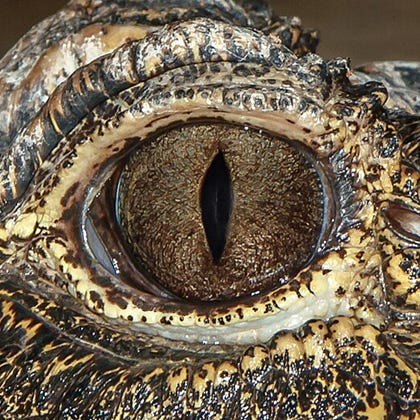
Whose Eye Was It?
The eye belongs to a dwarf crocodile. Photo credit: H. Zell — Wikimedia Commons.

Thanks for reading. For past editions, see the Archive. If you found it interesting or useful, please share and subscribe. If you want to get in contact, you can reach me at: thenaturebeat@substack.com.
Take A Trip to Planet Ficus
My other newsletter Planet Ficus is devoted to stories about the world’s most fascinating plants — the strangler figs and their kin, which have shaped our world and our species in profound ways. Over the past year, I’ve taken readers to rainforest canopies and city streets, explored ancient scriptures and modern science, and followed threads that connect ecology and culture around the world. If that sounds interesting, you can subscribe here or check out my selection of top stories published so far.
Another brilliantly informative post Mike, thank you.