

Nature Beat #112
Updates, stories, resources and opportunities

Welcome to the latest edition of Global Nature Beat. This edition includes:
Updates on the illegal wildlife trade, forest finance, pollinators, critical natural systems, AI and the environment, forest-risk commodities.
Features about citizen-based reforestation, mining no-go zones, forest carbon projects and ecology, impossible aims of restoration, ghost gear pollution.
Journal papers on rebounding river life, nutritionally useful trees, Amazon biosphere reserves, millions more insect species, mowing and invertebrates, how invasive species displace people, kelp forest conservation, large herbivores in disturbed forests, watershed tree diversity and ecological functions, and more.
Plus, the usual mix of news from around the world, useful resources, jobs and opportunities for environmental journalists, and more.
Taking The Pulse
Illegal wildlife trade: On 29 June, a coalition of conservation organizations released a report accusing Meta — the parent company of Facebook, Instagram and WhatsApp — of hosting the world’s “largest single known illegal wildlife trade market”. The report says Meta’s algorithms actively connect and reward traffickers. Its authors want the US Congress to end legal loopholes that allow social media companies to claim immunity from liability for third-party content. The report came six days after global tech giants made new commitments to end the sale of illegal wildlife products on their platforms.
Forest finance: Steven Swinford reports that the United Kingdom was on the brink of investing £400 million in the Tropical Forest Forever Facility (TFFF) — a mechanism Brazil is developing to reward countries that stop deforestation — but pulled back because of concerns about how it would look to the British public. Meanwhile, in a statement issued on 23 June, a group of 12 investors and the Luxembourg Stock Exchange endorsed the TFFF. The Finance for Biodiversity Foundation is encouraging other investors to sign the statement ahead of its formal launch in October. Also backing the TFFF is The Nature Conservancy. On 21 June, it announced US$5 million in financial support.
Pollinators: A new white paper by eight research consortia warns that the resilience of Europe’s “vital societal functions and food security are at stake” unless the European Union halts and reverses wild pollinator declines and does more to support managed pollinators. The report highlights incoherent policies and siloed governance as barriers to pollinator recovery. Presenting 15 recommendations, it calls for cross‑sectoral stewardship tackling all drivers of decline. See the press release or the full paper.
Critical natural systems: A new report argues that certain ecosystems are so important to national and global prosperity, resilience and security that they should be treated as “too big to fail” and given extra oversight and protection. These critical natural systems include forests, rivers, biodiversity hotspots and productive land. The report was published on 22 June by the Grantham Research Institute on Climate Change and the Environment at the London School of Economics and Political Science. It states that over US$1 trillion of annual GDP in each of China, Europe and the United States depends on forest-linked rainfall, making forests critical infrastructure. See the press release or the full report.
AI: On 23 June, UN Secretary-General António Guterres announced the AI Environmental Transparency Initiative, calling on AI companies to disclose carbon, water and land impacts of their systems and commit to powering them with renewable energy by 2030.
Deforestation: On 23 June, the UK government announced long-anticipated plans to issue regulations that would end imports commodities produced on illegally deforested land — see the press release or the policy brief. The regulations will cover cattle, cocoa, coffee, palm oil, rubber and soy, as well as certain derivative products such as chocolate. The NGO Forest Coalition welcomed the news but pointed out that nearly five years have passed since the UK adopted the Environment Act 2021, which established the powers to enact the new regulations. In that time, the UK imported commodities linked to more than 54,000 hectares of tropical deforestation, according to Global Witness. Unlike the EU Deforestation Regulation, the new UK rules will cover only illegal deforestation, though the government says its long-term aim is to align with the EU and require products to be produced without any deforestation. Meanwhile, investors with more than €5.5 trillion in assets are calling for timely and consistent implementation of the EU Deforestation Regulation.
In The Spotlight
Severin Carrell reported on what may be the largest citizen-based reforestation project of its kind, in which volunteers hand‑collected 11 million seeds to revive Scotland’s shrinking Atlantic rainforest.
Rebecca L. Root wrote about how climate change is increasing human‑snake encounters and worsening global antivenom shortages.
Perrine Fournier argues that mining no‑go zones are essential to protect ecosystems and Indigenous rights from rising mineral demand.
Chris Lang reported on new research showing that most forest carbon projects deliver weak or harmful ecological outcomes, exposing major design flaws.
Jonathan Tonkin argues that ecological restoration must prioritise ecosystem processes over impossible returns to historical baselines.
Robert Bociaga reports that India’s west‑coast fishers create persistent ‘ghost gear’ pollution due to routine losses and weak disposal and recycling systems.
From The Journals
Increasing forest disturbance boosts habitat for Europe’s large herbivores — read the full paper.
The true number of insect species may be 14 to 20 million, more than two to three times higher than current estimates — read the press release or the full paper.
More tree species means more ecological functions in watersheds worldwide — read the full paper.
Restoring native tree species can help combat malnutrition in Africa — read the press release or the full paper.
The Insect Calculator: an evidence-based online tool showing the negative effects of mowing on insects and spiders — read the press release or the full paper.
Biodiversity recovery is slow after clear-cut harvesting of boreal forests — read the press release or the full paper.
Analysis of seven biosphere reserves in Western Amazon shows they are effective in reducing deforestation but forest loss is increasing across all sites — read the full paper.
Four priority actions for the conservation of primary and old-growth forests in Europe — read the full paper.
A global review of kelp forest conservation, restoration and stewardship — read the press release or the full paper.
What to do about invasive species that drive human displacement — read the full paper.
Environmental regulations and best management practices likely explain long-term gains in water quality and increased occurrence of aquatic species across river basins in Ohio — read the press release or the full paper.
Carbon dioxide removals by tropical moist forests offset most land-use emissions across 18 African countries — read the full paper.
What Caught My Eye
The International Union for Conservation of Nature’s new assessment of 91 conservation projects in 31 African countries identifies which approaches work best.
The Philippines needs 15,000 forest rangers but has only 2,200, reports Rhick Lars Albay.
Carbon markets may have acquired “a symbolic prominence that exceeds their actual and potential future financial contribution” to forest conservation, and this brings risks, says Lian Pin Koh.
The H5N1 bird flu virus, which has killed millions of birds and mammals worldwide, has been found in Australia for the first time.
Nature4Climate shared 13 lessons from the Nature Hub at London Climate Action Week 2026.
Ten years after Wales enacted its Well-Being of Future Generations Act, it remains the only country with such a law, writes Daniel Martin Eckhart.
Paul Hormick wrote about growing resistance to data centres in the United States.
Greenpeace plans to dump boulders in UK marine protected areas to deter trawlers, as it says the government is failing to act.
A new joint report by WWF, GuArdean and TRAFFIC says tiger trafficking persists in Southeast Asia because prosecutions are inconsistent, opaque and rarely punish high‑level offenders.
Indonesia is considering a bid to host the COP18 UN biodiversity summit in 2028.
Matteo Civillini reports that diplomats fear plastics‑treaty talks may sideline essential limits on soaring production.
India’s first 3D-printed artificial reef modules have been installed in coastal waters of Tamil Nadu state in a marine habitat restoration initiative, reports SV Krishna Chaitanya.
Private sector investment in nature grew five-fold over the past decade and is accelerating, according to a new report by Forest Trends and The Nature Conservancy.
How to Support Global Nature Beat
I publish this newsletter as a free service to thousands of readers in more than 120 countries. If that is something you can support, please consider becoming a paying subscriber for less than £1 a week. If you can spare that, you will be helping me to keep Global Nature Beat going for those who cannot afford to pay.
Tips And Resources
The team behind the Climate.gov website shut down by the Trump administration has launched Climate.us to ensure that reliable information on climate change remains publicly available.
Hannah Ritchie created an interactive tool that visualizes flows of forest-risk commodities between producers and consumer countries — read about it here.
On 27 July, the Convention on Biological Diversity will hold a press conference to open the 2026 sessions of two of its subsidiary bodies in Nairobi — register here to attend online or in person.
Carbon Brief launched Project Cosmos, the world’s largest database of climate change research — read about it here.
Joseph A. Davis wrote about databases that can help journalists track AI‑driven data centres and their environmental impacts.
See past editions for more tips and resources.
Jobs And Opportunities
The Climate Storytellers Lab will train and fund 36 local storytellers to produce impactful climate stories across Indonesia, the Philippines and Thailand – deadline 2 July.
The African Investigative Journalist of the Year Award is open for entries — deadline 10 July.
Nature is hiring a chief magazine editor — deadline 13 July.
Journalismfund Europe has grants for cross-border environmental investigations — deadline 6 August.
The Times-Picayune/The Advocate is seeking a reporter to cover environmental issues affecting the state of Louisiana — no deadline listed.
The Fund for Investigative Journalism is offering grants for reporters to produce impactful stories — deadline 14 September.
Bonus content: There are 38 jobs, grants, fellowships and other opportunities listed here for Global Nature Beat’s paying supporters. Paid subscriptions are less than £1 per week.
On The Horizon
6-10 July 2026: The European Congress of Conservation Biology will take place in Leiden, the Netherlands.
13-16 July: The 34th meeting of the Convention on International Trade in Endangered Species (CITES) Animals Committee takes place.
17 July: A joint session of the Convention on International Trade in Endangered Species (CITES) Animals and Plants Committees takes place.
27 July - 1 August: The 28th Meeting of the CBD Subsidiary Body on Scientific, Technical and Technological Advice takes place in Nairobi, Kenya.
Bonus content: The full calendar for Global Nature Beat’s supporters includes nature-related intergovernmental negotiations, scientific conferences, report launches, and other events up until 2029.
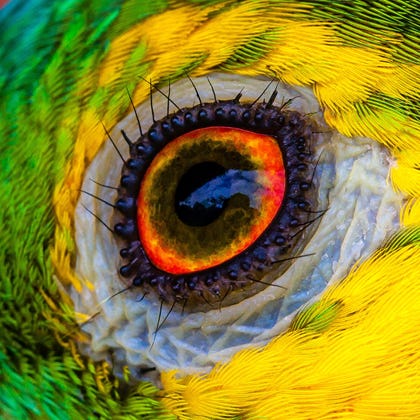
Whose Eye Was It?
The eye belongs to an orange-winged amazon. Photo credit: Rodrigo José Fernandes — Wikimedia Commons.

Thanks for reading. For past editions, see the Archive. If you found it interesting or useful, please share and subscribe. If you want to get in contact, you can reach me at: thenaturebeat@substack.com.
Take A Trip to Planet Ficus
My other newsletter Planet Ficus is devoted to stories about the world’s most fascinating plants — the strangler figs and their kin, which have shaped our world and our species in profound ways. Over the past year, I’ve taken readers to rainforest canopies and city streets, explored ancient scriptures and modern science, and followed threads that connect ecology and culture around the world. If that sounds interesting, you can subscribe here or check out my selection of top stories published so far.
Thanks for mentioning The Green Dispatch!
Thanks for mentioning climate.us!🌱🌿💚