

Nature Beat #111
Updates, stories, resources and opportunities

Welcome to the latest edition of Global Nature Beat. This edition includes:
Updates on the UK government response to calls for a national public briefing on the climate and nature emergency, environmental stakes of Colombia’s Presidential election, outcomes of the Our Ocean conference, the Elders and a UN Planetary Council, and how titans of finance keeps funding deforestation.
Features about a vast wildlife bridge, lost ecological knowledge, conservation education, overlooked ecosystem emissions, coexistence with baboons, community-led marine protection, and more.
Journal papers on India’s biodiversity law, trade-offs between vertebrates and crops in Africa, inequitable access to green space in US cities, negative perceptions of owls in Nigeria, a price-tag for environmental impacts of top consumers, biocultural approaches to restoration, Indigenous knowledge for conservation, socially sound nature-based solutions, colonialism and the biodiversity-poverty paradox.
Plus, the usual mix of news from around the world, useful resources, jobs and opportunities for environmental journalists, and more.
Taking The Pulse
Illegal logging: Civil society organizations from Africa, Asia, Latin America and the UK have written to the European Commission to protest its unilateral cancellation of Voluntary Partnership Agreements (VPAs) on legal timber trade between the European Union and tropical forest countries, reports Ama Kudom-Agyemang. They say the move is “illegitimate” and could lead to an increase in deforestation and an erosion of civic space. The European Parliament voted on 16 June to terminate the VPA with Liberia. Last year, the European Commission cancelled the VPA with Cameroon. Another eight VPAs remain in place. They have had varying degrees of success at combating illegal logging but all have helped improve forest governance — see Fern’s analysis of the VPA with Liberia.
Colombia: In an election that will have consequences beyond national borders, Colombians will vote on 21 June to elect a new President. One candidate — Iván Cepeda — pledges to continue the current policy of phasing out fossil fuels. His opponent Abelardo de la Espriella wants to expand extraction. Beyond energy, the candidates’ opposing visions extend to land reform, Indigenous rights and approaches to armed groups—issues that directly influence deforestation, environmental crime and community security. It will be a pivotal election for the Amazon, climate commitments and the future of Colombia’s environmental leadership. Read more about what’s at stake in articles by Aimee Gabay or Sam Meadows.
Forest 500: The global finance sector is dragging its feet when it comes to ending investment in deforestation, according to Global Canopy’s latest Forest 500 report. It looked at the 150 financial institutions providing finance to the 500 companies worldwide whose involvement in commodity production and trade has the greatest influence on deforestation. The report shows that 59 percent of these financial institutions — including major asset managers such as BlackRock, State Street and Vanguard — have no deforestation policy. Calling for anti-deforestation policies and more regulation, the report says: “The finance sector’s unwillingness to prioritize the link between deforestation and financial stability hinders action on forest loss and — ironically — increases financial risk.”
Emergency briefing: A petition calling on the UK government to broadcast a national emergency briefing on the climate and nature crisis passed a threshold requiring the government to respond. But that response — issued on 15 June — has not satisfied the campaign. It issued its own statement that said:
The government’s response answers the question: ‘Is the government aware of these risks?’ It does not answer the question: ‘How do we ensure that the public is aware of them?’
If 100,000 people sign the petition, there will be a debate in parliament. Meanwhile, the parliamentary Environmental Audit Committee says the government has refused to provide the unabridged version of its recent report on national security risks related to global biodiversity loss and ecosystem collapse. On 17 June, the committee’s chair wrote to Nature Minister Mary Creagh again requesting the report. On 8 July, the committee will hold an evidence session covering the assessment and other issues.
A Planetary Council: On 19 June, the Elders — a group of global leaders formed by Nelson Mandela — issued a statement calling for the creation of a Planetary Council as a subsidiary body of the United Nations to drive joined-up action on climate change, biodiversity loss, land degradation, pollution and other issues. “The current system is operating in silos. We need more urgent and coordinated action.” The Elders urge all candidates to be the next UN Secretary-General to support their ideas. For more on this topic, see Madelyn MacMurray’s interview of Nathalie Pettorelli, lead researcher of a recent report on the risks of treating nature and climate as separate issues.
Our Ocean Outcomes
At the 11th Our Ocean Conference in Kenya on June 16-18, governments, businesses and nongovernmental organizations announced 320 pledges valued at US$6.4 billion to support ocean conservation, sustainable fisheries, climate resilience and the blue economy — see the Commitment Tracker or the conference outcome report for details.
Susan Lieberman, Vice President of International Policy at the Wildlife Conservation Society said:
“This week exceeded our expectations in terms of advancing strong commitments for actions that have tremendous potential to truly lead to equitable and effective protection and conservation of ocean ecosystems, for the benefit of biodiversity and the local communities around the globe that depend on that biodiversity and healthy marine environments.”
Among the pledges, new initiatives announced and reports released at the conference:
Kenya announced more than 40 commitments worth an estimated US$1 billion.
The European Union committed €338.35 million to support ocean conservation, sustainable fisheries and maritime security — see the press release for details of where the money will go.
The UK announced £13.9 million in new funding for three international programmes addressing ocean protection, coastal resilience and plastic pollution.
Fifteen countries in Africa, Asia, Latin America and Europe committed to improve transparency and data-sharing to combat illegal, unreported and unregulated fishing.
WWF published a brief report outlining its ideas for achieving the global target of conserving 30 percent of the ocean by 2030.
The Smithsonian Tropical Research Institute released a report showing that while countries are increasingly declaring marine protected areas, many lack the people, institutions and funding needed to make them effective — see the story by Rob Hutchins, or this article by the report’s authors.
Nine African governments announced new marine protections.
Kenya, Comoros, the Dominican Republic, Mexico, and the United Kingdom became the latest signatories of a commitment to protect and conserve climate-resilient coral reefs.
Madagascar and Zanzibar announced new national protections for sharks and rays.
Indonesia, Malaysia, Papua New Guinea, Philippines, Solomon Islands, and Timor-Leste signed the Women Ocean Guardians Voluntary Commitment, joining eight other governments
Canada and Jamaica will host the Our Ocean Conference in 2027 and 2029, respectively.
In The Spotlight
A letter to David Attenborough: Anish Mokashi says children’s education must cover colonial destruction of wildlife and the conservation wisdom of indigenous communities.
How to live with baboons in South Africa? One village shows how, reports Barry Christianson.
James Dinneen reported on overlooked ecosystem emissions that could accelerate global warming beyond what current climate models anticipate.
Donna Ferguson reported that the Biodiversity Heritage Library’s vast 64 million‑page archive faces closure without urgent new funding.
David Akana reported on community-based marine conservation groups in Kenya, Tanzania and Namibia whose underfunded work is contributing to global biodiversity goals.
Karen L. Masters wrote that Indigenous language loss mirrors and accentuates biodiversity decline, by erasing vital ecological knowledge needed for conservation.
In an extract from his new book Ryan Huling reported on a vast wildlife bridge in California that will reconnect fragmented habitats and could help save inbred mountain lions from extinction.
In Focus: Food Demand and Biodiversity Loss
Over the past week, scientists and journalists around the world have reported various ways that consumer demand for certain types of food is harming biodiversity in specific locations.
In a new research paper, Mustafa Saifuddin and colleagues showed how factory farming of pigs in three of the United States poses risks to endangered and threatened species there.
Journalists Isabel Alarcón, Lise Josefsen Hermann and Marcello Rossi reported how global demand for farmed shrimp from Ecuador harms the country’s mangrove forests and coastal livelihoods.
Suzana Camargo wrote about recent research showing that rising demand for the ‘superfood’ açaí is linked to declining bird diversity in the Amazon.
Manuela Callari reported on rampant sea urchin poaching for a popular spaghetti dish in Naples, Italy.
Shuntian Wang and colleagues published a paper linking oil palm, coconut and soybean production with species extinction, particularly in tropical countries that serve demand from China, Europe and the United States — the full paper is paywalled but there is a press release.
From pigs to shrimp, açaí to pasta, these cases reveal how our appetites can have profound and often overlooked consequences for nature.
From The Journals
Widespread negative perceptions of owls create challenges to conservation in Nigeria — read the full paper.
How Indigenous knowledge systems shape conservation outcomes — read the press release or the full paper.
The discriminatory housing policy of redlining and the distribution of green spaces in US cities — read the full paper.
How trade-off risks between vertebrate biodiversity and crop production vary across Ethiopia, Ghana, and Zambia — read the full paper or a plain language summary.
A critical review of India’s Biological Diversity Act 2002 and its implementation gaps — read the full paper.
On the need for biocultural approaches to ecological restoration — read the full paper.
How to bring social equity into nature-based solutions — read the full paper.
Colonialism explains a biodiversity-poverty paradox and means conservation needs a rethink — read the full paper or the plain language summary.
The top ten percent of global consumers cause trillions of dollars of environmental damage, highlighting the potential of taxes based on the ‘polluter pays’ principle — read the press release or the full paper.
What Caught My Eye
India has launched the world’s first certification scheme rewarding businesses for sharing benefits derived from their use of biodiversity.
A survey of 120 journalists across Nigeria, Kenya, Uganda and Zambia found that forestry, biodiversity and the broader environment receive only marginal media coverage…
… and, in a survey of 80 journalists in the United Kingdom, only 18 percent said their organization’s climate change reporting is fully serving audience needs, while 89 percent said new approaches are needed.
Natalie Jane Cibel reported on Mexico–US turtle trafficking driven by organized crime and aided by weak border enforcement.
Bård Harstad argues that the Tropical Forest Forever Facility will likely fail, urging greater use of sustainability‑linked bonds instead.
More than 12,500 plant and fungal species were named as new to science in 2024 and 2025 according to this year’s State of the World’s Plants and Fungi report.
Fionagh Thomson wrote about the challenge journalists face covering a major ocean threat because it is invisible.
The Bezos Earth Fund committed US$26 million to support the world’s first satellite constellation dedicated to detecting wildfires.
Youth-led biodiversity conservation and restoration initiatives worldwide face significant funding challenges, says a new report.
Fishing vessels are likely catching tens of thousands of sea turtles each year in the Indian Ocean and Southeast Asia, according to a new report.
How to Support Global Nature Beat
I publish this newsletter as a free service to thousands of readers in more than 120 countries. If that is something you can support, please consider becoming a paying subscriber for less than £1 a week. If you can spare that, you will be helping me to keep Global Nature Beat going for those who cannot afford to pay.
Tips And Resources
Joseph A. Davis wrote a backgrounder on the projected ‘super’ El Niño and what it means for the climate and food security.
The Global Biodiversity Information Facility has a new website.
Carbon Pulse launched its Biodiversity Portal to track submissions of National Biodiversity Strategy and Action Plans and mentions of biodiversity credits — see the press release for details.
On 22 June, Chatham House has a hybrid event at which three leaders of climate change COPs past and future will discuss the state of environmental diplomacy — register here.
On 24 June, the Pulitzer Center has a webinar on conflict between community forests and mining in the Democratic Republic of the Congo — register here.
A new guide for aspiring science journalists in North Macedonia.
On 24 June, the Pulitzer Center has a webinar on how to use the Earth Index Deep Search tool to find features such as mines, roads and plantations across the planet in minutes — register here.
On 25 June, Luís Fernando Guedes Pinto, executive director of Fundação SOS Mata Atlântica will give a talk about how Brazil’s Atlantic Forest stands at a crossroads: continued deforestation or a future shaped by regeneration — register to attend online to attend online or in person in Oxford.
See past editions for more tips and resources.
Jobs And Opportunities
The Association of Young Environmental Journalists has story grants for student journalists in the Philippines — deadline 22 June.
The Earth Journalism Network is offering fellowships for journalists to cover the UN Biodiversity Conference (COP17) in Yerevan, Armenia — deadline 29 June.
The Pulitzer Center invites content creators in Latin America to apply to its Waki initiative for support to develop digital narratives inspired by investigative journalism on forests, climate and other environmental issues — deadline 5 July.
Journalists from South and Southeast Asia can apply to join a 3-day residential training workshop on reporting on environmental crises that will take place in August in Sri Lanka — deadline 5 July.
Mongabay and Ladera Sur are offering grants for short videos in Spanish on environmental topics in Latin America — deadline 8 July.
Contexte is hiring a Brussels-based environment reporter — no deadline listed.
The Earth Journalism Network invites Kenya-based journalists to join a three-day workshop on biodiversity reporting — deadline 11 July.
KERA and Grist are seeking a climate, energy and environment reporter to cover North and West Texas — no deadline listed.
Mongabay is hiring an associate editor to work with its StoryTransformer tool — no deadline listed.
The Earth Journalism Network has story grants for journalists reporting on apes in Asia — deadline 18 July.
Mongabay is hiring a senior video story editor to boost its visual journalism on conservation and environmental science — no deadline listed.
Oceanographic and Kanaloa seek a data journalist focused on ocean health — no deadline listed.
The team behind the 2027 World Conference of Science Journalists in London invites proposals for workshops, panels and other sessions — deadline 30 November.
Bonus content: There are 39 jobs, grants, fellowships and other opportunities listed here for Global Nature Beat’s paying supporters. Paid subscriptions are less than £1 per week.
On The Horizon
29 June – 1 July: The Royal Botanic Gardens at Kew, in London, UK, will host the State of the World’s Plants and Fungi Symposium.
6-10 July 2026: The European Congress of Conservation Biology will take place in Leiden, the Netherlands.
13-16 July: The 34th meeting of the Convention on International Trade in Endangered Species (CITES) Animals Committee takes place.
17 July: A joint session of the Convention on International Trade in Endangered Species (CITES) Animals and Plants Committees takes place.
Bonus content: The full calendar for Global Nature Beat’s supporters includes nature-related intergovernmental negotiations, scientific conferences, report launches, and other events up until 2029.
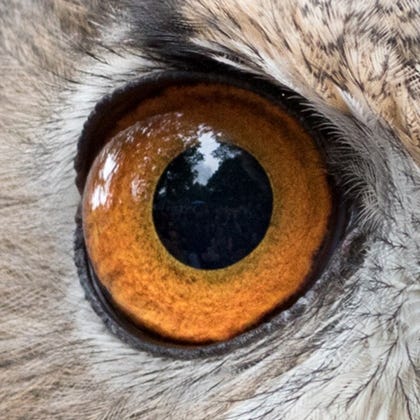
Whose Eye Was It?
The eye belongs to an Eurasian eagle-owl. Photo credit: Rhododendrites — Wikimedia Commons.
.jpg)
Thanks for reading. For past editions, see the Archive. If you found it interesting or useful, please share and subscribe. If you want to get in contact, you can reach me at: thenaturebeat@substack.com.
Take A Trip to Planet Ficus
My other newsletter Planet Ficus is devoted to stories about the world’s most fascinating plants — the strangler figs and their kin, which have shaped our world and our species in profound ways. Over the past year, I’ve taken readers to rainforest canopies and city streets, explored ancient scriptures and modern science, and followed threads that connect ecology and culture around the world. If that sounds interesting, you can subscribe here or check out my selection of top stories published so far.