

Nature Beat #110
Updates, stories, resources and opportunities

Welcome to the latest edition of Global Nature Beat. This edition includes:
Updates on ocean challenges and protections, the roles of wildlife in climate change, Indonesia’s mega-deforestation project, the spread of screwworm.
Features about how mining may drive Ebola outbreaks, a long-lost butterfly, nature’s scent signals, bees and human health, kelp forest restoration, archaeological sites with rich biodiversity, and more.
Journal papers on oil palm as a conservation opportunity, Brazil’s overlooked wetland carbon store, overlapping human and conservation needs in Vietnam, COVID and insect biodiversity, climate change and medicinal plants in China, Amazon fragmentation, invasive river species, economic risks of biodiversity loss, and more.
Plus, the usual mix of news from around the world, useful resources, jobs and opportunities for environmental journalists, and more.
Taking The Pulse
Screwworm: A parasitic screwworm — really a fly larva — is spreading among cattle and other animals in the United States, years after having been eradicated there and in all countries as far south as Panama. The flesh-eating insect can be deadly to cows, wildlife, pets and people. A paper published in the journal Conservation Biology on 10 June reported that the explosive re-emergence of the New World screwworm across Mesoamerica has been driven largely by illegal cattle movement. The authors say the parasite poses rising and under‑monitored threats to wildlife, protected areas and regional conservation efforts — see also the related press release from the Wildlife Conservation Society. US-funded efforts to prevent screwworm from entering the United States were cut last year by the Department of Government Efficiency led by Elon Musk.
Wildlife and climate: On 11 June, scientists launched a consensus statement synthesizing evidence of the roles wild animals play in climate change mitigation and adaptation. The Scientific Consensus on Wildlife and Climate highlights how animals shape the global carbon cycle and patterns of ecosystem regeneration, for example as seed dispersers of trees. More than 280 scientists have backed the statement, which was developed through a process facilitated by the World Federation for Animals and the International Fund for Animal Welfare. It urges governments to account for ecological processes in climate policies — watch the press conference or read the press release.
Ocean: On 8 June, the UN released the third World Ocean Assessment, a report drawing on the work of 600 experts in 86 countries. As might be expected, it highlights a litany of challenges linked to pollution, overfishing and climate change, and calls for global cooperation to conserve marine ecosystems. On 9 June, French Polynesia announced it would give the highest level of protection to a France-sized area of ocean. No mining, trawling or industrialized fishing will be permitted in the zone, which forms the single largest contribution to the global goal of conserving 30 percent of land and sea by 2030. Two days later, US President Donald Trump removed restrictions on commercial fishing in parts of three Marine National Monuments in the Pacific Ocean.
Indonesia: Indonesian media recently reported that former President Megawati Soekarnoputri said she cried while watching Pesta Babi (Pig Feast), a new documentary about a vast deforestation project underway in the country’s Papua region. The film highlights the destruction of rainforest and its impacts on local communities, featuring testimony from a woman named Mama Yasinta Moiwend. On 8 June, BBC News Indonesia reported that Mama Yasinta had been flown to Jakarta without her family’s knowledge. She was seen there with security personnel and lawyers linked to the governing political party, and later issued a statement saying she had not wanted to appear in the film and no longer opposed the project. The episode has fuelled speculation that she may have been pressured to reverse her stance — see Glenn Hurowitz’s summary, the Pesta Babi trailer or the full documentary.
In The Spotlight
Aynsley O’Neil interviewed biologist Panayiotis Pafilis about his research showing that 20 archaeological sites shelter 11 percent of Greece’s native species despite covering just 0.018 percent of its area.
Meng Kroypunlok reported on how part of a protected Cambodian forest became a special economic zone that enabled scam operations, human rights abuses and impacts on biodiversity.
Kathleen Dean Moore wrote about the return of a long-lost butterfly and how collective habitat restoration can spark hope in a time of ecological loss.
Hannah Thomasy reported that pollution and climate change are degrading nature’s scent signals, disrupting vital insect communication and threatening pollination and biodiversity.
Gloria Dickie reported that collapsing wild bee populations are undermining nutrition, incomes and public health from Nepal to Europe.
Richard Schiffman reported that scientists and Indigenous groups are trying to save vanishing kelp forests by culling urchins, breeding heat‑tolerant strains and scaling up restoration.
Sonia Shah explored potential links between mining and Ebola outbreaks in the Congo Basin.
From The Journals
Nearly all of Vietnam’s priority areas for conservation both remain unprotected and are areas of high human development needs — read the full paper.
Wetlands in the Brazilian savanna store six times more carbon per hectare than Amazonian forests – read the press release or the full paper.
Extreme rain and landslides in Indonesia last year may have wiped out about one in ten members of the world’s rarest great ape species, whose total population is less than 800 — read the full paper.
Conservation status and climate vulnerability of nearly 6,000 medicinal plant species in China — read the full paper.
Biodiversity loss could trigger sovereign debt crises — read the press release or the full paper.
Oil palm landscapes are both a major driver of biodiversity loss and an untapped conservation opportunity — read the full paper.
Reduced human activity during the COVID-19 pandemic supported measurable but transient improvements in insect pollinator biodiversity in China — read the full paper.
Forest fragmentation in the Amazon’s arc of deforestation — read the full paper.
River barrier removals aid invasive species too — read the full paper or a commentary by three of the authors.
What Caught My Eye
“Its findings are a call for urgent, whole-of-government and whole-of-society acceleration and a compass where to focus” — Astrid Shomaker, the head of the UN Convention on Biological Diversity reflects on the draft report showing inadequate progress towards the global biodiversity goals.
Fredrick Mugira writes that African environmental journalism routinely sidelines the lived expertise of frontline communities in favour of elite voices, creating gaps that weaken public understanding and accountability.
In a new report on ecosystem integrity, Greenpeace says the defining question for forest governance is now not whether forests remain standing, but whether they remain functioning.
A new analysis exposes the scale of marine bycatch killed by UK fishing vessels, reports Karen McVeigh.
Corey Bradshaw says confirmation of the world’s largest island eradication of invasive pigs is a monumental outcome for biodiversity conservation, not just for Australia but globally.
The World Economic Forum published a global report on plastic pollution and biodiversity.
Luxembourg pledged 50 million euros to the Tropical Forests Forever Facility’s investment fund, which it will host.
Everland launched a new financing initiative designed to provide community-led forest conservation projects with capital.
Umar Manzoor Shah wrote about a recent report showing that Brazil and Cameroon lose billions of dollars each year because of illegal logging and illicit financial flows.
A report from the Toda Peace Institute warns that a ‘narco-mineral complex’ is emerging in parts of the Amazon Basin, driven in part by growing demand for raw materials needed for the green energy transition.
In a new paper, the International Alliance against Health Risks in Wildlife Trade is calling for stronger controls on trade in live wild animals to reduce the risk of diseases spreading to people and potentially causing future pandemics.
Colombia has become the first tropical forest country to enact a law requiring its cattle industry to prove that beef supply chains are free from deforestation, reports Steven Grattan.
How to Support Global Nature Beat
I publish this newsletter as a free service to thousands of readers in more than 120 countries. If that is something you can support, please consider becoming a paying subscriber for less than £1 a week. If you can spare that, you will be helping me to keep Global Nature Beat going for those who cannot afford to pay.
Tips And Resources
On 17 June, the Society of Environmental Journalists has a webinar on energy reporting for environmental journalists — register here.
The Secretariat of the UN Convention on Biological Diversity (CBD) is holding a series of webinars to provide updates on progress and information on agenda items at the forthcoming meetings of the CBD’s subsidiary bodies.
The International Federation of Journalists launched a free online course on reporting on climate change.
UNESCO published Reporting the Environment, a manual for journalists.
In a webinar on 19 June, the Environmental Reporting Collective will discuss online suppression of its investigation into a Google data centre in India — register here.
Climate Tracker International is expanding its environmental press network in Latin America and Caribbean — find out more and register interest in joining here.
On 25 June, Australia’s Nature Media Centre is holding a webinar on environmental podcasting — register here.
IUCN published an ’issues brief’ on biofuels and biodiversity.
Carbon Brief launched Cited, a newsletter covering the latest climate science.
The World Health Organization is providing an online masterclass series on natural environments and health.
See past editions for more tips and resources.
Jobs And Opportunities
Mongabay is hiring a managing editor for Africa — no deadline listed.
The Earth Journalism Network is offering fellowships to the COP31 climate change conference in Antalya for journalists and for content creators — deadline 17 June.
ENDS Report is hiring a news editor — deadline 21 June.
The 2026 European Science Journalist of the Year Award is open for entries — deadline 30 June.
The Earth Journalism Network invites journalists in the Western Balkans to apply to attend a four-day workshop in Montenegro on biodiversity and environmental reporting — deadline 1 July.
The Fetisov Journalism Awards are open for entries, with one category for Excellence in Environmental Journalism — deadline 15 September.
Bonus content: There are 31 jobs, grants, fellowships and other opportunities listed here for Global Nature Beat’s paying supporters. Paid subscriptions are less than £1 per week.
On The Horizon
8-18 June: The UN Framework Convention on Climate Change’s intersessional conference is underway in Bonn, Germany.
14-16 June: The G7 Summit takes place in Évian, France.
14-19 June: The World Biodiversity Forum will take place in Davos, Switzerland.
16-18 June: The Our Ocean Conference takes place in Mombasa, Kenya.
20-28 June: London Climate Action Week.
Bonus content: The full calendar for Global Nature Beat’s supporters includes nature-related intergovernmental negotiations, scientific conferences, report launches, and other events up until 2029.
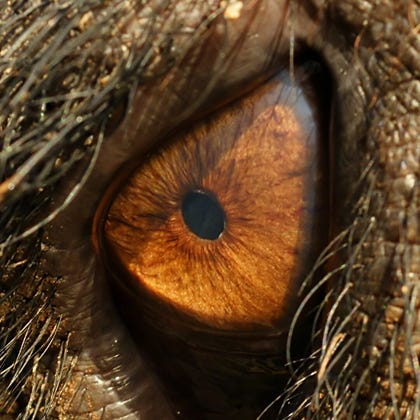
Whose Eye Was It?
The eye belongs to an Indian elephant. Photo credit: Alexander Klink — Wikimedia Commons.

Thanks for reading. For past editions, see the Archive. If you found it interesting or useful, please share and subscribe. If you want to get in contact, you can reach me at: thenaturebeat@substack.com.
Take A Trip to Planet Ficus
My other newsletter Planet Ficus is devoted to stories about the world’s most fascinating plants — the strangler figs and their kin, which have shaped our world and our species in profound ways. Over the past year, I’ve taken readers to rainforest canopies and city streets, explored ancient scriptures and modern science, and followed threads that connect ecology and culture around the world. If that sounds interesting, you can subscribe here or check out my selection of top stories published so far.