

Nature Beat #109
Updates, stories, resources and opportunities

Welcome to the latest edition of Global Nature Beat. This edition includes:
Updates on the progress toward global biodiversity targets, climate and nature policy silos, the state of India’s environment, controversy in Albania, Global Environment Facility millions, and more.
Features about rewilding in Europe, reintroducing tigers to Cambodia, Ebola-deforestation links, krill supertrawlers versus whales, the biodiversity financing gap, and more.
Journal papers on payments for conservation performance, environmental crime, minerals and nature loss, forest restoration in China, umbrella species in India, mining’s deforestation footprint in Africa, and more.
Plus, the usual mix of news from around the world, useful resources, jobs and opportunities for environmental journalists, and more.
Taking The Pulse
Biodiversity: Too little, and not fast enough: that sums up the extent of progress toward the global goals of halting and reversing the loss of nature by 2030, according to a draft report that the Secretariat of the UN Convention on Biological Diversity (CBD) released on 2 June. The report says:
“Addressing the gaps in and barriers to collective progress will require addressing their underlying reasons, including those related to limited ambition, implementation, means of implementation, environmental governance and policy coherence, whole-of-society engagement, and data and knowledge.”
The draft report is a beast — more than 340 pages long. It is open for review and comments until 29 June. A new draft will be available by 18 July and the final version will be published in time for the 17th Conference of Parties to the CBD, in Armenia in October.
Climate v. Nature: Treating climate change, biodiversity loss and land degradation as separate issues is doomed to fail, says an international group of scientists and policy experts in a report published on 2 June. It warns that policies on climate change and nature are badly misaligned, leading to costly failures, missed opportunities and unintended harm. The authors outline how to break down the silos at national and international levels, including through greater alignment of the three UN conventions on climate, biodiversity and desertification — read the press release or the full report.
Europe: A new survey of around 26,500 citizens of EU countries shows near universal public support for protecting biodiversity. The Eurobarometer survey results, published on 3 June, showed that 93-96 percent of respondents agreed that halting the loss of biodiversity is important morally, for health and wellbeing, for economic development, to tackle climate change, and for producing goods. Only 42 percent had heard of the EU’s Natura 2000 network of protected areas, but this was an increase of twelve percentage points since last year’s survey. See the press release or the full results.
India: On 4 June, the Centre for Science and Environment and Down To Earth magazine published their annual State of India’s Environment report. It paints a picture of rising challenges linked to deforestation, waste management, tiger and elephant attacks, water stress and climate change. One statistic that leapt out at me: India experienced extreme weather on 99 per cent of all days in 2025. These events claimed 4,421 lives and damaged 17.4 million hectares of crops.
Albania: Thousands of people took to the streets in Albania this week to oppose plans — by companies linked to Donald Trump’s son-in-law Jared Kushner — to develop a luxury resort in an ecologically important coastal area. Judd Legum reports that the area was previously part of a national park, until the government changed its status to allow the project to go ahead. Albania’s national anti-corruption agency is now investigating this change and the transfer of rights to the project developers. An investigative report by Vladimir Karaj sheds light on some of the unusual processes and shady characters associated with the project. Meanwhile, BirdLife reports that heavy machinery has already been active at the site, without permits or an environmental impact assessment. It calls on the Albanian government to halt all works, restore the damage and launch a legal investigation into what has happened.
GEF: The Global Environment Facility approved more than US$230 million in funding for projects in 22 countries at its Council meeting in Uzbekistan this week. The money will flow from various GEF-managed funds to support biodiversity conservation, adaptation to climate change, and so on. The GEF Council also endorsed the programming directions and policy recommendations for 2026-2030, during which the GEF will aim to spend US$3.9 billion pledged by donor countries. See the press release.
In The Spotlight
Alice Sun reported on scientists extracting the DNA of birds and mammals from blood-sucking and scavenging invertebrates to reveal hidden biodiversity and track pathogens.
Christina Egerstrom writes that Europe’s rewilding revival shows ecosystems can rapidly rebound when keystone species return.
Luc van Vliet argues that the ‘financing gap’ narrative masks the inherent contradiction between a global extractivist economy that destroys nature and global commitments to protect biodiversity.
Andy Ball and Arathi Menon report that plans to release Bengal tigers in Cambodia face ecological, governance, and community‑safety concerns.
Ashoka Mukpo spoke to Carson Telford about his research on the link between Ebola and deforestation, and how understanding it could help stop outbreaks early on.
Jim Robbins reports that growing fleets of krill supertrawlers threaten whales already stressed by rapid Antarctic climate change.
From The Journals
The world’s oldest scheme providing payments for conservation performance is losing legitimacy — read the press release or the full paper.
Protecting the habitat of any one of nine key ‘umbrella’ species could safeguard over a third of India’s above-ground carbon and vertebrate diversity — read the full paper.
Conservation policy and practice should approach criminal justice with caution — read the full paper.
Commodity-specific maps of mining-induced nature loss across 70,000 sites and 20 mined commodities can inform targeted mitigation strategies — read the full paper.
Ecosystem services, synergies and trade-offs of forest restoration in China — read the full paper.
Lose elephants, lose dung beetles and the important ecological roles they play in African savannas — read the press release, the full paper or the associated commentary paper.
Across sub-Saharan Africa, every hectare of forest lost to mining triggers another 34 hectares of off-site deforestation — read the press release or the full paper.
Most of Africa’s biodiversity is outside formal protected areas, so new models of outcome-based governance are needed in working landscapes — read the press release or the full paper.
What Caught My Eye
Conservationists are dismayed that at least 89 countries will no longer be eligible for funding from the UK government’s Darwin Initiative, reported Fiona Harvey.
On 1 June, Greenpeace International released a report calling for a human rights-based approach to marine conservation and efforts to protect at least 30 percent of the ocean — see the press release or the full report.
In Australia, the Biodiversity Council published a report assessing the impacts on nature caused by the country’s 200 largest publicly listed companies.
Michel Valette and Gail Sucharitakul argue that the right of Indigenous Peoples to give their free, prior and informed consent to activities that could affect them should be extended to non-Indigenous communities.
Aisiri Amin reports that India’s flagship tree‑planting schemes miss targets when they lack community‑led, livelihood‑focused design.
Yvonne Buckley writes that Ireland’s new nature restoration targets are creating a fast‑growing, long‑term career ecosystem spanning science, technology, community work and industry.
Alongside water and energy concerns, AI expansion is a biodiversity issue, says Theresa Lieb.
Earth League International released an investigation showing links between Cambodia’s wildlife trafficking networks and organized crime.
Carol Yuen and Catherine Higham write that China’s new Environmental and Ecological Code lacks targets, coordination and oversight, limiting its effectiveness.
Over the decade to 2024, more than 450 protected birds of prey were illegally killed in the UK on or near land managed for game shooting, reports Justin Rowlatt.
Ryan Lobo says India’s wildlife laws need to be reformed to allow faster action against dangerous animals, community benefit-sharing and regulated, science-based sustainable use of wildlife.
On 1 June, Norway announced it will provide NOK 1.5 billion (US$ 165 million) to partnerships with civil society organizations worldwide to protect tropical forests.
How to Support Global Nature Beat
I publish this newsletter as a free service to thousands of readers in more than 120 countries. If that is something you can support, please consider becoming a paying subscriber for less than £1 a week. If you can spare that, you will be helping me to keep Global Nature Beat going for those who cannot afford to pay.
Tips And Resources
On 11 June, the International River Foundation, Wetlands International and Shoal are hosting a webinar on how to halt and reverse the loss of freshwater biodiversity — register here.
RECOFTC published factsheets on eight diverse Model Forest landscapes managed for sustainability in six Asian countries.
What’s the difference between restoration and rewilding? Sandra Cordon explains.
On 26 June, the Science Journalists Association India has a webinar on data tools for climate journalists — register here.
See past editions for more tips and resources.
Jobs And Opportunities
Mongabay invites applications for its Southeast Asia Ocean Reporting Fellowship — rolling deadline.
Journalists outside of the United States can apply for the Ocean Nexus International Fellowship — deadline 14 June.
The Earth Journalism Network has story grants for journalists in Ethiopia, Indonesia, Kenya, Kyrgyzstan and Madagascar reporting on biodiversity and nature-based solutions — deadline 30 June.
The New York Times is hiring a climate policy correspondent — no deadline listed.
The Boston Globe is hiring a climate science and environment reporter — no deadline listed.
Bonus content: There are 26 jobs, grants, fellowships and other opportunities listed here for Global Nature Beat’s paying supporters. Paid subscriptions are less than £1 per week.
On The Horizon
5 June: World Environment Day
8-18 June: The UN Framework Convention on Climate Change’s intersessional conference takes place in Bonn, Germany.
14-16 June: The G7 Summit takes place in Évian, France.
14-19 June: The World Biodiversity Forum will take place in Davos, Switzerland.
Bonus content: The full calendar for Global Nature Beat’s supporters includes nature-related intergovernmental negotiations, scientific conferences, report launches, and other events up until 2029.
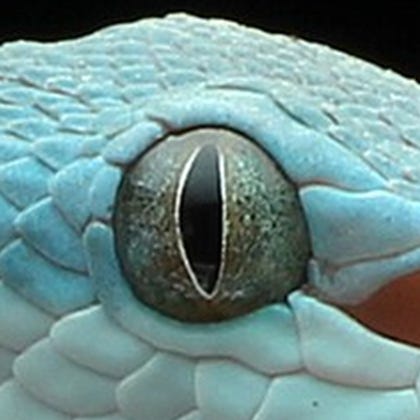
Whose Eye Was It?
The eye belongs to a blue insularis pit viper. Photo credit: RidhaAnshari85 — Wikimedia Commons.

Thanks for reading. For past editions, see the Archive. If you found it interesting or useful, please share and subscribe. If you want to get in contact, you can reach me at: thenaturebeat@substack.com.
Take A Trip to Planet Ficus
My other newsletter Planet Ficus is devoted to stories about the world’s most fascinating plants — the strangler figs and their kin, which have shaped our world and our species in profound ways. Over the past year, I’ve taken readers to rainforest canopies and city streets, explored ancient scriptures and modern science, and followed threads that connect ecology and culture around the world. If that sounds interesting, you can subscribe here or check out my selection of top stories published so far.
As always - stellar curation of insights, Mike - most appreciated (also, I need more hours in my day to even just come close to reading all of everything of value you share!