

Nature Beat #105
Updates, stories, resources and opportunities

Welcome to the latest edition of Global Nature Beat. This edition includes:
Updates on business and security risks linked to nature loss, the EU Deforestation Regulation, another mangrove superpower, tropical forest loss.
Features about the EU Habitats Directive, trophy hunting in Africa, tortoise guardians in India, rays of hope for troubled migratory fish, community coexistence with lions in Zimbabwe, and one of the largest wildlife‑crime raids in US history.
Journal papers on downsides of ecotourism, conservation in India, wind farms and birds, REDD+ successes, wild meat consumption in Central Africa, impacts of deep-sea mining, poaching in Romania, and more.
Plus, the usual mix of news from around the world, useful resources, jobs and opportunities for environmental journalists, and more.
Taking The Pulse
Risk: Nature loss is increasingly breaking out of the ecology bubble, as understanding of the risks it poses to businesses, investors and national security grows. On 30 April, the Institute and Faculty of Actuaries and Anglia Ruskin University warned in a report that biodiversity loss, climate shocks and geopolitical conflict are disrupting food systems, risking “catastrophic impacts for the financial system and for society as a whole” — see the press release. The report urges actuaries and the financial sector to recognize that food system fragility is a systemic financial risk, whose impacts far exceed the contribution of agriculture to GDP. It calls for urgent investment to support sustainable land use, protect pollinators and strengthen supply-chain resilience. In related news this week:
Kristen French interviewed two authors of a recent study that assessed 27 cases where disrupted ecosystems intensified societal unrest and political instability, threatening national security.
Gabriella Sotelo wrote about the links between deforestation, biodiversity loss and diseases that are deadly to people
Sarah DeWeerdt reported on “defensive rewilding”, a new proposal by researchers who argue that restoring wetlands, forests and other ecosystems can simultaneously strengthen national security and deliver major climate and biodiversity benefits.
Forest loss: The planet lost a Denmark-sized area of tropical forest — some 4.3 million hectares — in 2025, according to the latest annual Global Forest Watch review based on satellite data. Many media reports focused on the fact that the area lost was 36 percent less than in 2024. On the face of it, this looks like good news. But that steep decline is because 2024 was a particularly bad year for wildfires, which greatly increased forest loss. Global Forest Watch’s long-term data shows that tropical deforestation driven by factors other than wildfire has been fairly consistent since 2002.
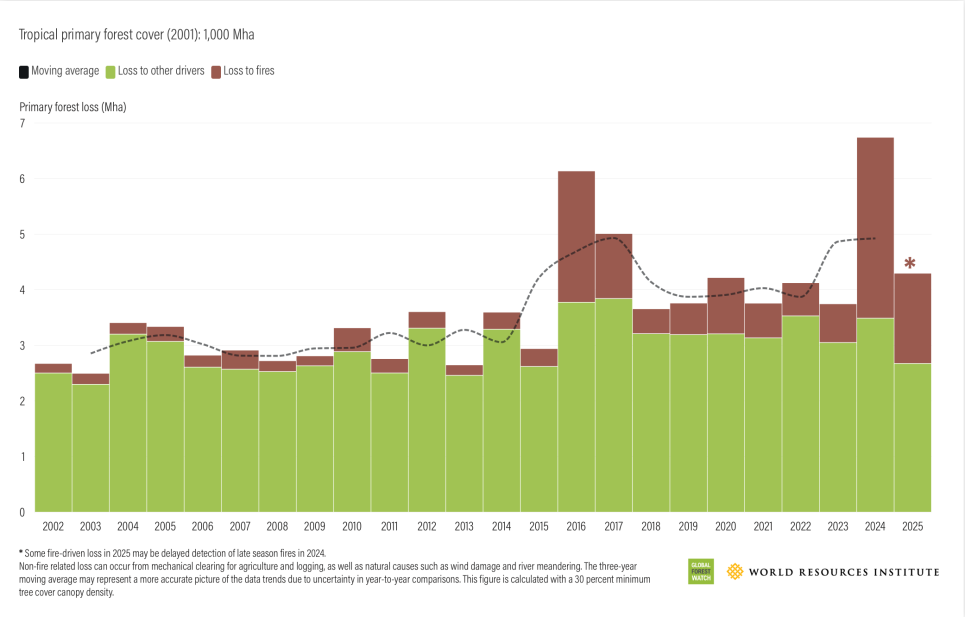
In the past decade, wildfires have added to this baseline, creating an overall upward trend. The deforestation rate last year was 70 percent greater than the level needed to achieve the internationally agreed goal of halting and reversing forest loss by 2030. The global data also masks big differences between countries. Deforestation in Brazil fell by 42 percent since 2024, but it rose by 14 percent in Indonesia. See the press release, Hans Nicholas Jong’s reporting on the data or Benji Jones’s article on Bolivia, where soaring deforestation is being driven by expanding Mennonite soy farms.
EUDR: On 4 May, the European Commission released the report of its ‘simplification review’ of the EU Deforestation Regulation, whose entry into application has been delayed for two years. The report confirms that the EUDR will face no further delays. The Commission says that new measures to simplify the law’s implementation, combined with previous measures, will reduce compliance costs for companies by about 75 percent, compared to costs under the original design of the EUDR — see the press release. The Commission also published a draft legal amendment to the scope of products covered by the EUDR — adding products such as soluble coffee and removing others including, most contentiously, leather. Rainforest Foundation Norway said in a press release that this would reward companies sourcing leather from areas deforested to raise cattle. The Commission is seeking public feedback on its proposed changes until 1 June.
Mangroves: Mangrove forests are widely recognized as major carbon sinks, protectors of coastlines and breeding grounds for fish and other marine life. New research shows that they also provide another valuable service: cleaning up nitrogen pollution from human activities, which can cause harmful algal blooms and deplete oxygen levels, threatening ecosystem health. The new research estimates that, globally, mangroves remove 870,000 metric tons of nitrogen from coastal ecosystems each year — a service worth about US$8.7 billion annually. This is twelve times more than the value of carbon sequestration by mangrove forests. The authors call for the creation of a market for ‘blue nitrogen credits’ to recognize this benefit of mangroves and incentivize their conservation.
In The Spotlight
Nick Davidson wrote about an undercover agent who infiltrated and exposed a violent poaching network, leading to one of the largest wildlife‑crime raids in US history.
Moushumi Basu reported on the successful rewilding of critically endangered Asian giant tortoises that is transforming former hunting villages in Nagaland, India into dedicated guardians of the species.
Christina Egerstrom wrote about why there are such big gaps between what the European Union’s Habitats Directive requires and what member states are delivering.
Stefan Lovgren reported on the rapid declines in migratory freshwater fish in rivers from the Amazon to the Mekong, and early signs of progress through new international action plans and rising political attention.
Matthew Pearce wrote about the work of Moreangels Mbizah, who is transforming lion conservation in Zimbabwe through community‑led strategies that dramatically cut conflict and protect both people and wildlife.
Planet Ficus at One
One year ago, I launched my second newsletter Planet Ficus. It is all about how one extraordinary group of plants — the strangler figs and their kin — can help us understand the living world and our place in it.
Currently, only ten percent of my Global Nature Beat subscribers are also receiving Planet Ficus. I would love to improve that ratio. Over the past year, I’ve taken readers to rainforest canopies and city streets, explored ancient scriptures and modern science, and followed threads that connect ecology and culture around the world. If that sounds interesting, you can subscribe here or check out my selection of top stories published so far.
From The Journals
The hidden environmental costs of ecotourism extend far beyond carbon footprints of travel — read the full paper.
Shifting biodiversity conservation in India from expanding protected area coverage towards climate-adaptive and landscape-scale strategies — read the full paper.
Many REDD+ projects have succeeded in reducing deforestation but issued too many carbon credits — read the press release or the full paper.
Assessment of wind-farm collision risks for 108 European bird species and mapping of risk hotspot areas — read the full paper.
Rising urban demand has driven an increase in wild animal consumption across Central Africa — read the press release or the full paper.
The Timor green pigeon of eastern Indonesia and Timor-Leste may be on the verge of extinction — read the press release or the full paper.
The environmental impacts of deep-sea mining — read the full paper.
Romanian media reports reveal the extent and nature of poaching in the absence of official data — read the press release or the full paper.
Patterns of growth and loss of tropical dry woodlands across India — read the full paper.
Future nickel mining sites in the tropics threaten high-priority areas for conserving terrestrial and marine biodiversity — read the press release or the full paper.
How to Support Global Nature Beat
I publish this newsletter as a free service to thousands of readers in more than 120 countries. If that is something you can support, please consider becoming a paying subscriber for less than £1 a week. If you can spare that, you will be helping me to keep Global Nature Beat going for those who cannot afford to pay.
In Focus: Trophy Hunting
Three pieces published in recent days highlight the complexity of debates about trophy hunting:
A case study published by the Center for Biological Diversity (CBD) showed that hunters imported more than 300 elephant trophies into the United States in 2025 — mostly from Botswana, which allows 400 of its 140,000 elephants to be shot each year. In a press release, the CBD stated: “Since trophy hunters generally remove large mature males who are also threatened by poaching and drought, these elephants could soon be depleted from the population, harming breeding, genetics and elephant social functioning.”
In a letter to The Guardian newspaper, researchers Amy Dickman and colleagues argued that calls to ban imports of hunting trophies are misguided, noting that trophy hunting benefits lions and many other species by conserving more land in Africa than national parks do. “Biodiversity is far more threatened by habitat loss, which bans are likely to amplify by reducing income for protected areas,” they wrote.
Conservation psychology researcher Stephanie Klarmann wrote that South Africa’s trophy‑hunting model concentrates power and profit among wealthy foreign hunters while undermining ecological integrity, community rights and non‑lethal conservation alternatives. “Wildlife is protected not because it is ecologically vital, culturally significant, or ethically deserving of life, but purely because it can be killed for a hefty price,” she wrote. “Creating a dependency on such a narrow revenue stream and outsourcing our wildlife conservation to markets not fully in South Africa’s control is precarious and economically fragile.”
What Caught My Eye
Countries are failing to uphold the UN declaration on Indigenous rights adopted in 2007, reports Dionne Phillips.
In the UK, analysis by DeSmog shows that 67 percent of the funding received by Nigel Farage’s Reform party — which is leading the polls and opposes climate action — has come from donors with financial interests in fossil fuels.
Chris Rapley wrote that humanity must abandon comforting myths and adopt a shared “spaceship Earth” narrative.
Alison Kentish reported that the Global Environment Facility’s new US$3.9 billion funding cycle aims to shift from isolated projects to supporting system‑wide transformations.
A new report by the Environment Investigation Agency shows how rhino breeders in South Africa are trying to get around the ban on international trade in rhino horns.
Andrew McKechnie and Susan Cunningham wrote about new research showing how rising heat and humidity are accelerating population declines of tropical birds.
Emelia Arthur — Ghana’s minister for fisheries and aquaculture — wrote about the country’s newly created and first marine protected area.
James Painter wrote about his research into how British newspapers report on net-zero policy — with marked differences between right-wing and left-leaning papers.
Benji Jones reported that US wildlife agencies depend on a 1930s gun tax for nearly a fifth of their budgets, creating a morally fraught incentive to promote firearms so they can fund conservation.
Robert Nasi and Paolo Omar Cerutti wrote about why the Congo Basin remains critically underfunded despite absorbing far more carbon than other tropical forests.
Tips And Resources
On 11 May, EurekAlert! has a webinar on essential skills for science journalists — register here.
On 12 May, a GroundWork webinar will discuss the status of the roadmaps on transitioning away from fossil fuels and halting deforestation that are being developed ahead of the COP31 climate change conference — register here.
On 13 May, CIFOR-ICRAF is hosting a webinar on wild meat consumption in Southeast Asia — register here.
On 21 May, David Cooper, the former Deputy Executive Secretary and Acting Executive Secretary of the UN Convention on Biological Diversity, will share his views on progress with the Global Biodiversity Framework — register to attend online or in person in Oxford, United Kingdom.
On 27 May, Future Earth will co-host a webinar exploring how climate tipping points are communicated — register here.
See past editions for more tips and resources.
Jobs And Opportunities
JournalismFund.eu is offering grants for cross-border investigations in Europe — deadline 21 May.
Lighthouse Reports is hiring a climate and environment editor — deadline 29 May.
POLITICO is hiring a journalist to help edit and lead its daily coverage of energy and environmental policy on Capitol Hill — no deadline listed.
Nature Kenya is recruiting 20 experienced journalists to be ‘environmental media champions’ —deadline 30 May.
The Knight-Risser Prize for Western Environmental Journalism is open for entries —deadline 2 June.
JournalismFund.eu’s Environmental Investigative Journalism Programme will fund cross-border teams of journalists to investigate environmental issues linked to European interests — deadline 6 August.
Bonus content: There are 32 jobs, grants, fellowships and other opportunities listed here for Global Nature Beat’s paying supporters. Paid subscriptions are less than £1 per week.
On The Horizon
6-7 May: The Global Landscapes Forum Africa 2026 conference takes place in Nairobi, Kenya and online.
11-14 May: The 20th International Conference on Community-Based Adaptation (CBA20) will be held in Manila, Philippines.
11-15 May: The UN Forum on Forests takes place in New York City, United States.
30 May - 6 June: The Global Environment Facility’s Eighth Assembly and Associated Meetings take place in Samarkand, Uzbekistan
1-6 June: Rio Nature & Climate Week takes place in Rio de Janeiro, Brazil.
Bonus content: The full calendar for Global Nature Beat’s supporters includes nature-related intergovernmental negotiations, scientific conferences, report launches, and other events up until 2028.
Whose Eye Was It?
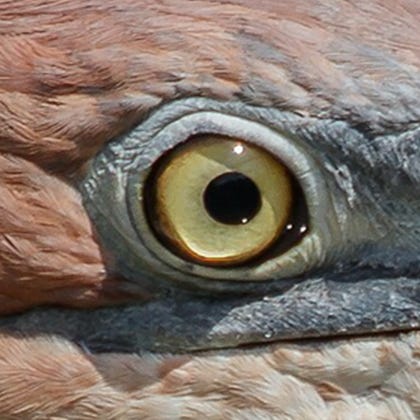
The eye belongs to a goliath heron. Photo credit: H. Zell — Wikimedia Commons.

Thanks for reading. For past editions, see the Archive. If you found it interesting or useful, please share and subscribe. If you want to get in contact, you can reach me at: thenaturebeat@substack.com.